
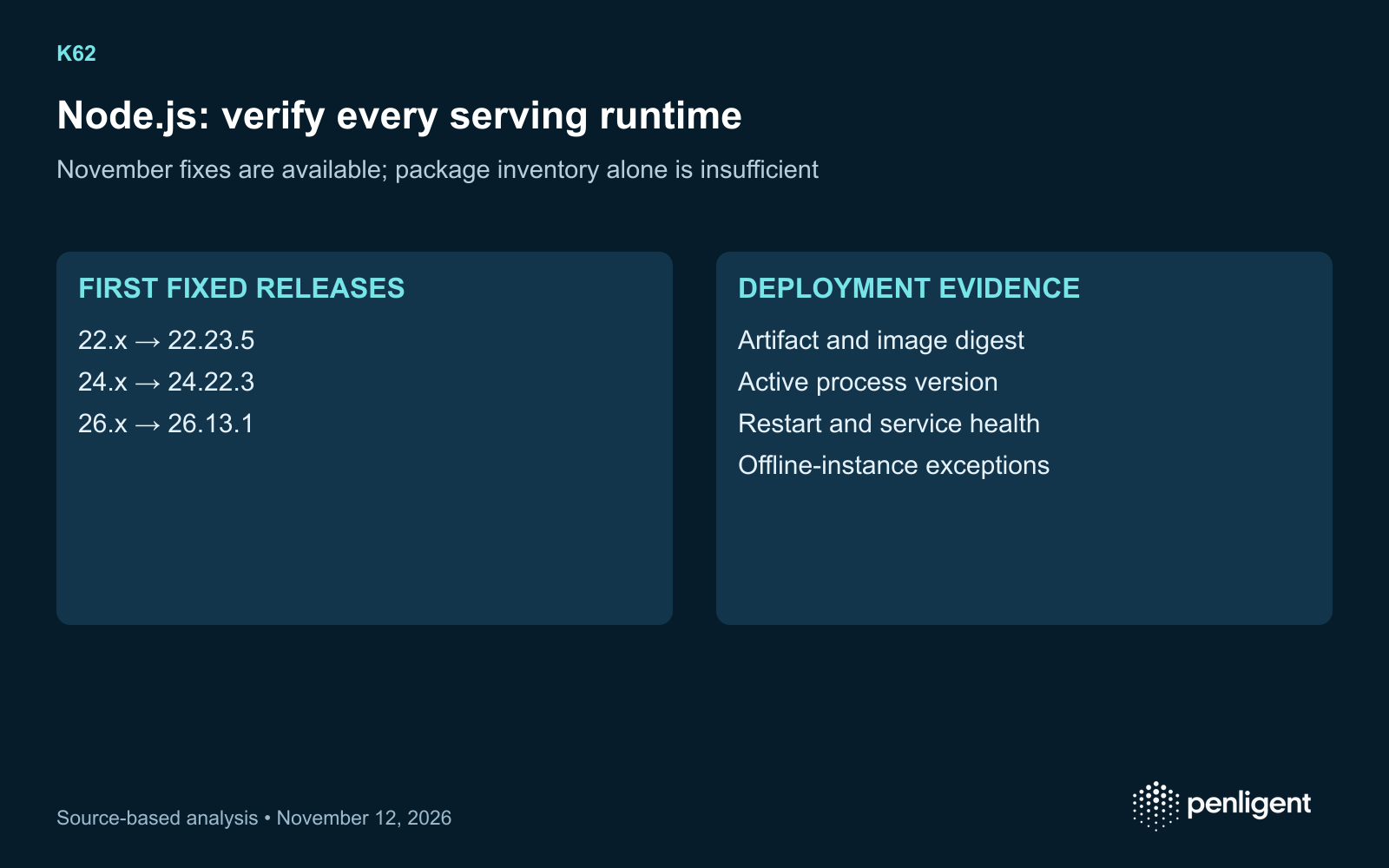
Updated November 12, 2026: the November 11 Node.js security releases are available as 22.23.5, 24.22.3 and 26.13.1. The final Node.js security announcement lists 16 patched issues, with High as the highest severity, plus dependency updates. Replace release-day preparation tickets with branch-specific deployment and active-process evidence.
Match the workload to its fixed branch
| Release line | Security release | Closure requirement |
|---|---|---|
| 22.x | 22.23.5 | Map the actual package or managed-provider build to this correction. |
| 24.x | 24.22.3 | Rebuild and reconcile serving instances, workers and scheduled jobs. |
| 26.x | 26.13.1 | Identify the running process, not only an available artifact. |
These are the security releases named in the November notice. Choose an appropriate current supported build rather than downgrading to a boundary version. For downstream packages, require the distributor’s explicit backport or fix statement. An end-of-life runtime needs a supported migration path; the Node.js notice says end-of-life versions are always affected when a security release occurs.
Prioritize by the affected feature and the application path
The rows below select operationally important conditions from the final notice. They are not the complete 16-issue list. The vendor advisory remains the source for the full descriptions and branch mapping; a version match alone does not show that every application exposes every mechanism.
| Issue | Affected maintained lines in the notice | Application question |
|---|---|---|
| CVE-2026-123863: HTTP/2 teardown assertion | 24.x, 26.x | Does the service expose HTTP/2, including handlers responding before the request body ends? |
| CVE-2026-123864: HTTPS parser re-entrancy and memory disclosure | 22.x, 24.x, 26.x | Review affected HTTPS handler behavior; cleartext node:http is outside this particular issue. |
| CVE-2026-123865: HTTP/2 shutdown resource leak | 22.x, 24.x, 26.x | Inventory direct and proxy-to-backend HTTP/2 paths. |
| CVE-2026-123866: HTTP/2 response memory disclosure | 22.x, 24.x, 26.x | Track teardown paths; the vendor distinguishes remote triggering on newer 24.x/26.x builds from application-initiated teardown across supported lines. |
| CVE-2026-126051: deferred TLS handshake callback crash | 24.x, 26.x | Identify services using the documented deferred callbacks or server.addContext(). |
| CVE-2026-123872: TLS 1.2 renegotiation and client-certificate policy | 22.x, 24.x, 26.x | Identify hostname-specific client-certificate authorization. |
| CVE-2026-123871: proxy credentials in configuration errors | 22.x, 24.x, 26.x | Review affected error/log exposure and credentials, separately from the binary rollout. |
| CVE-2026-123829: recursive watch permission leak | 22.x, 24.x, 26.x | Applies to the described macOS/Windows Permission Model case; exposed filenames are not file contents. |
Prove which runtime handles work
Capture the executable path, runtime version, deployment revision and instance identity from trusted startup or restricted process diagnostics. Node.js documents process.version and process.execPath. Running node -v in a fresh shell identifies that new process, which may differ from a long-lived worker.
For containers, retain the approved immutable image digest and reconcile it against every serving replica, queue worker and scheduled job. For managed functions, identify all invocable versions and aliases. Replacing a binary or publishing an image does not restart an already running process. Avoid creating a public diagnostic endpoint to collect this evidence.
| Record | Evidence needed | Keep open when |
|---|---|---|
| Official correction | Dated release, branch and package/provider fix mapping | Only a mutable tag or unrelated latest-version label is available. |
| Deployment | Artifact digest and revision for every relevant workload | Old replicas or function versions can still receive work. |
| Active process | Version and executable path tied to instance identity | Evidence comes only from an administrator’s shell. |
| Behavior | Startup, critical paths and relevant feature regression checks | A rollback restores the affected runtime or workers fail to restart. |
Keep runtime, dependencies and incident response separate
npm audit and an application SBOM describe package dependencies; they do not prove which Node.js binary serves requests. Conversely, upgrading the runtime does not resolve every application package finding. The security notice also names llhttp, undici and sqlite dependency updates for specific release lines: retain the final notice with the chosen artifact rather than guessing that all branches embed identical components.
Where an issue can expose memory or credentials, assess the relevant data and credential implications through the organization’s incident process. A patch closes a vulnerable code path; it does not establish whether past exposure happened. Do not infer exploitation solely from the severity label or claim no exploitation without evidence.
Close the rollout with an evidence handoff
Require the service owner to record the official correction, approved artifact, active-process observations, fleet exceptions and successful ordinary business checks. Repeat permitted controls after the upgrade so service failure cannot appear to be a security success. If rollback is necessary, record the returned exposure and route it to the owner. Close only the workloads supported by the collected evidence.
For a separately authorized application assessment, define the reachable surface and evidence requirement when evaluating Penligent. Runtime patch closure remains supported by the deployment records above.
The official Penligent 3.0 video illustrates the general product workflow. It does not demonstrate testing of these Node.js vulnerabilities.
Revision: the former release-preview wording was replaced with the final November 11 release mapping and source-backed configuration checks. This AI-assisted editorial update, verified November 12, 2026, includes a proposed operational method; no exploit or customer environment was tested.


 English
 German
 French
 Spanish
 Portuguese
 Japanese
 Korean
 Hindi
 Arabic
 Turkish
 Hebrew