
In the austere landscape of 2026 cybersecurity, the term pentest ai has shed its early skin of marketing hyperbole to reveal a formidable reality. For the veteran security engineer—the professional who has spent thousands of hours in IDA Pro and Burp Suite—the emergence of IA agêntica represents the first true discontinuity in the history of offensive security.
We are no longer discussing “tools” that require a human operator to pull the trigger. We are discussing Autonomous Cyber-Physical Systems capable of reasoning, planning, and executing complex exploit chains at a velocity that exceeds human cognitive limits.
This manifesto serves as a technical demarcation line. On one side lies the legacy era of static scanners and manual scripting. On the other lies the era of Autonomous Reasoning Engines. Here, we deconstruct the architecture of modern pentest ai, analyze the neural mechanics of exploiting high-complexity CVEs, and demonstrate why platforms like Penligente are not just tools, but necessary teammates in the asymmetric warfare of network defense.
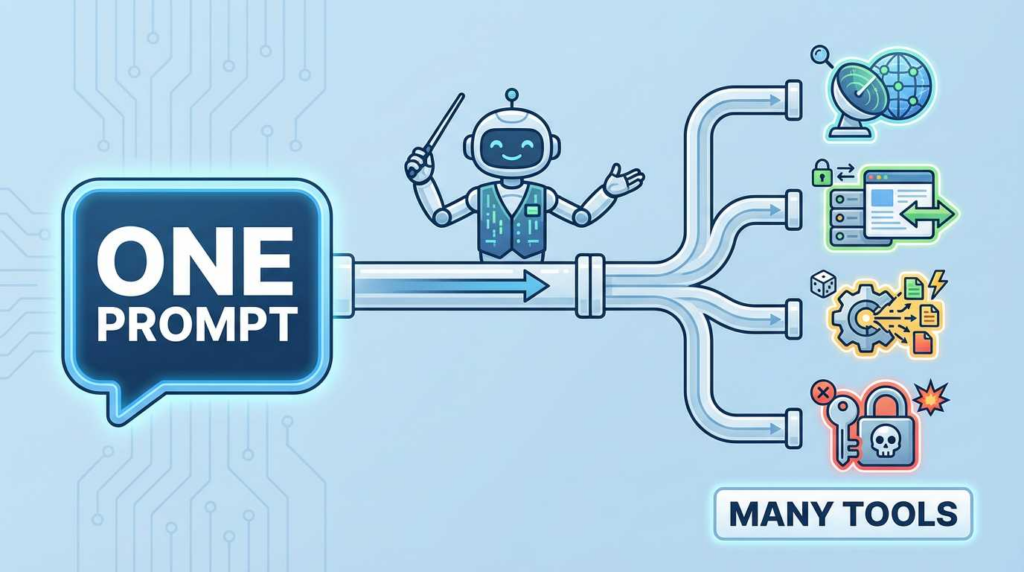
I. The Cognitive Architecture: From Regex to Reasoning
To understand the profound shift in pentest ai, one must first understand the limitations of the past. Traditional DAST (Dynamic Application Security Testing) tools operate on deterministic logic: Input A + Signature B = Alert C.
This logic fails in the face of modern, complex architectures. A microservices-based application does not have a single “vulnerability”; it has “emergent flaws” that only appear when three separate services interact in a specific sequence.
The Rise of the Large Action Model (LAM)
The modern pentest ai agent is built upon a Large Action Model (LAM). Unlike a Large Language Model (LLM) which predicts the next word, a LAM predicts the next state transition.
1. The OODA Loop Implementation
True pentest ai implements the military OODA Loop (Observe-Orient-Decide-Act) directly into its kernel.
- Observe (Perception Layer): The agent ingests raw data—PCAP files, HTML DOM trees, binary disassembly. It uses Graph Neural Networks (GNNs) to map the relationships between assets.
- Orient (Context Layer): The agent accesses a Vector Database (RAG) containing the latest threat intelligence (e.g., specific TTPs for a detected Nginx version).
- Decide (Reasoning Layer): Utilizing Cadeia de pensamento (CoT) prompting, the agent formulates a hypothesis. “If I trigger a race condition on the SSH port, does the kernel version suggest I can overwrite the glibc heap?”
- Act (Execution Layer): The agent generates and executes the exploit code within a sandboxed environment, measuring the result.
2. Neuro-Symbolic AI: The Solver of Logic
Pure neural networks are probabilistic; they “guess.” Pure symbolic execution is mathematical; it “proves.” The cutting edge of pentest ai in 2026 is Neuro-Symbolic AI.
We use the Neural Network to prune the search space (identifying “interesting” code paths), and the Symbolic Engine to solve the constraints required to reach that path. This hybrid approach allows us to find deep logic bugs that fuzzers miss and humans overlook.
II. The Great Filter: LLM Wrappers vs. Autonomous Engines
The market is saturated with “AI Pentest Tools.” For the serious engineer, distinguishing between a toy and a weapon is critical.
The “Wrapper” Trap
An “LLM Wrapper” is simply a script that pipes Nmap output to GPT-4 and asks, “What does this mean?”
- Stateless: It forgets port 80 was open by the time it scans port 443.
- Hallucinogenic: It suggests exploits that don’t exist.
- Toothless: It cannot execute. It tells você to run the exploit.
The Autonomous Engine (The Penligent Standard)
Plataformas como Penligente represent the Engine class. These systems maintain a Global State Machine of the target infrastructure.
| Recurso | Legacy Scanner (Nessus) | LLM Wrapper (ChatBot) | Autonomous Engine (Penligent) |
|---|---|---|---|
| Memory Architecture | None (Log file only) | Sliding Window (Short-term) | Knowledge Graph (Long-term Persistence) |
| Exploit Generation | Pre-canned Scripts | Hallucinated Code Snippets | Compiler-Verified Binary Generation |
| Error Handling | Reports “Failed” | Apologizes | Self-Corrects (e.g., Adjusts padding) |
| Movimento lateral | Impossible | Theoretical | Autonomous (Pivots via SMB/WMI) |
III. Protocol-Level Violence: AI Exploitation of Critical CVEs
The true test of pentest ai is not writing a phishing email; it is exploiting memory corruption and race conditions. Let us examine two defining vulnerabilities of the era to see how AI outperforms human operators.
Deep Dive A: CVE-2024-6387 “regreSSHion” (The Race Condition)
A vulnerabilidade:
A signal handler race condition in OpenSSH’s sshd. If a client does not authenticate within LoginGraceTime, sshd receives a SIGALRM asynchronously. If this signal interrupts code that is not async-signal-safe (like syslog()), it can leave the heap in an inconsistent state, potentially allowing for Remote Code Execution (RCE) as root.
The Human Problem:
Exploiting this requires hitting a microscopic time window. It involves network jitter, server load, and OS scheduling. A human attacker running a script is essentially gambling.
The AI Solution: Reinforcement Learning (RL) Optimization
A pentest ai agent treats this exploit as a Markov Decision Process (MDP).
- State ($S_t$): Current average Round Trip Time (RTT), server response variance, previous attempt failure code.
- Action ($A_t$): The precise microsecond delay before sending the final packet.
- Reward ($R_t$):
- 0: Connection closed normally (Fail).
- 0.1: Connection crashed (Partial Success – Race triggered but crashed).
- 1.0: Root shell obtained.
Code Block: The Agent’s Internal Logic (Conceptual)
Python
`class RegreSSHionAgent(RLAgent): def policy_network(self, observation): # Observation includes granular network telemetry jitter = observation[‘network_jitter’] server_load = observation[‘tcp_timestamps’]
    # The Neural Network predicts the optimal offset based on current chaos
    predicted_delay = self.model.predict(jitter, server_load)
    return predicted_delay

def adapt(self, result):
    if result == 'SEGFAULT':
        # We hit the race but corrupted memory wrongly.
        # Adjust Heap Spray allocation size.
        self.model.adjust_hyperparameters(heap_size='+128B')
    elif result == 'TIMEOUT':
        # We missed the window entirely.
        # Shift timing window left.
        self.model.adjust_timing(shift='-5ms')`
In this scenario, the AI “learns” the server’s heartbeat, achieving a success rate mathematically impossible for a static script.
Deep Dive B: CVE-2024-3400 (PAN-OS Logic & Injection)
A vulnerabilidade:
A command injection vulnerability in Palo Alto Networks PAN-OS GlobalProtect. The flaw allowed unauthenticated attackers to execute arbitrary code with root privileges by manipulating the SESSID cookie.
The Complexity:
This was not a simple s injection. It required traversing directories and manipulating the telemetry service to execute the file later via a cron job.
The Agentic Reasoning Chain:
A simple scanner sees “Port 443 Open.” A pentest ai agent sees a graph of possibilities.
- Impressão digital: O Agente identifica o
Etagsand specific HTTP headers that reveal the exact PAN-OS version. - Recuperação de conhecimento: It queries its internal vector database for “PAN-OS + File Write + Root”.
- Constraint Solving: The Agent realizes it cannot execute commands directly. It must deduce a path to persistence.
- Payload Synthesis: The Agent constructs a multi-stage payload.
- Stage 1: Write a shell script to
/opt/panlogs/tmp/device_telemetry/minute/. - Stage 2: Wait for the system’s internal scheduler to execute the telemetry bundle.
- Stage 3: Catch the reverse shell.
- Stage 1: Write a shell script to
This ability to plan asynchronously—to plant a seed and wait for it to grow—is the hallmark of advanced pentest ai.

IV. The Penligent Paradigm: Level 4 Autonomy
In the classification of autonomous driving, Level 4 implies “High Automation” where the system handles all aspects of the dynamic driving task. In security, Penligente is the first platform to aim for Level 4 Pentesting.
Beyond “Point and Shoot”
Most tools are “Point and Shoot”—you give them a URL, they attack that URL. Penligente operates on Campaigns.
When you deploy a Penligent agent, you give it a Directive: “Demonstrate the feasibility of exfiltrating the customer database from the DMZ.”
The Architecture of Penligent
- The Scout (Reconnaissance): Uses passive DNS, Shodan data, and active probing to map the attack surface. It builds a graph where nodes are assets and edges are potential trust relationships.
- The Strategist (Planner): Uses a fine-tuned LLM (specifically trained on diverse CTF data and real-world breach reports) to generate an attack graph. It prioritizes paths that are “Quiet” over paths that are “Easy.”
- The Operator (Executor): This is the hands-on-keyboard module. It compiles exploit code, manages C2 (Command and Control) channels, and performs privilege escalation.
The “Human-in-the-Loop” Dashboard
Crucialmente, Penligente solves the “Black Box” problem. Every decision the AI makes is logged in a human-readable trace.
- “I detected a WAF blocking SQL injection.”
- “I am switching to Time-Based Blind Injection with varying sleep intervals to evade detection.”
- “I have successfully bypassed the WAF.”
This transparency allows security engineers to trust the bot, transforming it from a “Magic Box” into a verifiable junior partner.
V. Adversarial AI: The Defense Strikes Back
We cannot discuss pentest ai without acknowledging the immediate counter-reaction. The very technology enabling these attacks is being used to thwart them.
1. AI-Driven WAFs (The Moving Target)
Traditional WAFs use RegEx. AI WAFs use anomaly detection. They learn the “grammar” of normal traffic. If a pentest ai agent sends a packet that is mathematically improbable (even if it contains no known signature), it is blocked.
- The Counter-Counter: Utilizações negligentes Generative Adversarial Networks (GANs). One model generates attack traffic, and another model (acting as the defender) tries to block it. The generator learns to “morph” the attack until it is indistinguishable from benign traffic.
2. Prompt Injection as a Defense
Defenders are now embedding “Honeypot Prompts” in their HTML comments and robots.txt files.
- Exemplo: “
- Endurecimento: Moderno pentest ai agents must be trained with Robustness Filters to ignore these “visual/textual” adversarial attacks, strictly adhering to their primary directive.
VI. The Future: The Centaur Engineer
The fear that pentest ai will replace the security engineer is unfounded. Instead, it will replace the bored security engineer.
The manual labor of pentesting—running Nmap, checking SSL ciphers, testing for default credentials—is drudgery. It is high-volume, low-value work. By offloading this to an Agentic System like Penligente, the human engineer is elevated.
The engineer becomes a Centaur:
- The Horse (AI): Provides the raw speed, the infinite memory, and the ability to test 10,000 payload variations per second against a glibc race condition.
- The Human (Head): Provides the strategic intent, the ethical constraints, and the ability to understand the impacto nos negócios of a technical flaw.
The 2026 Toolkit
To thrive in this era, your stack must evolve:
- Infrastructure: Kubernetes (for orchestrating agent swarms).
- Raciocínio: Penligente (for autonomous execution).
- Analysis: Ghidra + AI Plugins (for assisted reverse engineering).
VII. Conclusion
The transition to pentest ai is not a feature update; it is a fundamental architectural change in how we approach information security. We are moving from a world of static assumptions to a world of dynamic reasoning.
For the hard-core security engineer, this is the most exciting time in history. The barriers to entry for mundane tasks are gone, replaced by an infinite ceiling for complex, creative, and high-impact vulnerability research. Whether you are analyzing the micro-architectural nuances of CVE-2024-6387 or orchestrating a red team campaign with Penligente, one thing is clear: The future belongs to the automated.
Referências
- Palo Alto Networks Unit 42: CVE-2024-3400 Technical Root Cause Analysis
- Qualys Security Blog: regreSSHion: The Signal Handler Race Condition (CVE-2024-6387)
- Penligent Technical Whitepaper: The Architecture of Agentic Security: Comparing PentestGPT and Penligent
- USENIX Security Symposium: SoK: Neural-Symbolic AI for Binary Analysis
- Penligent Blog: Automating the Impossible: AI-Driven Logic Flaw Discovery
 Portuguese
  English
  German
  French
  Spanish
  Japanese
  Korean
  Hindi
Hindi  Arabic
  Turkish
  Hebrew