
CVE-2026-119618 is a critical memory-corruption vulnerability in Apache HTTP Server’s mod_http2. Apache identifies a synchronization error in assign_headers() that can lead to remote code execution. Its security advisory lists HTTP Server 2.4.55 through 2.4.70 as affected and places the fix in 2.4.71, released November 11, 2026. Separately distributed GitHub mod_h2 releases 2.0.8 through 2.0.42 are also listed as affected.
The practical task is to connect that component range to the HTTP/2 path actually serving your traffic, then establish that the patched component is running. A version string, a successful HTTP request, and a completed package transaction answer different questions.
What the published patch establishes
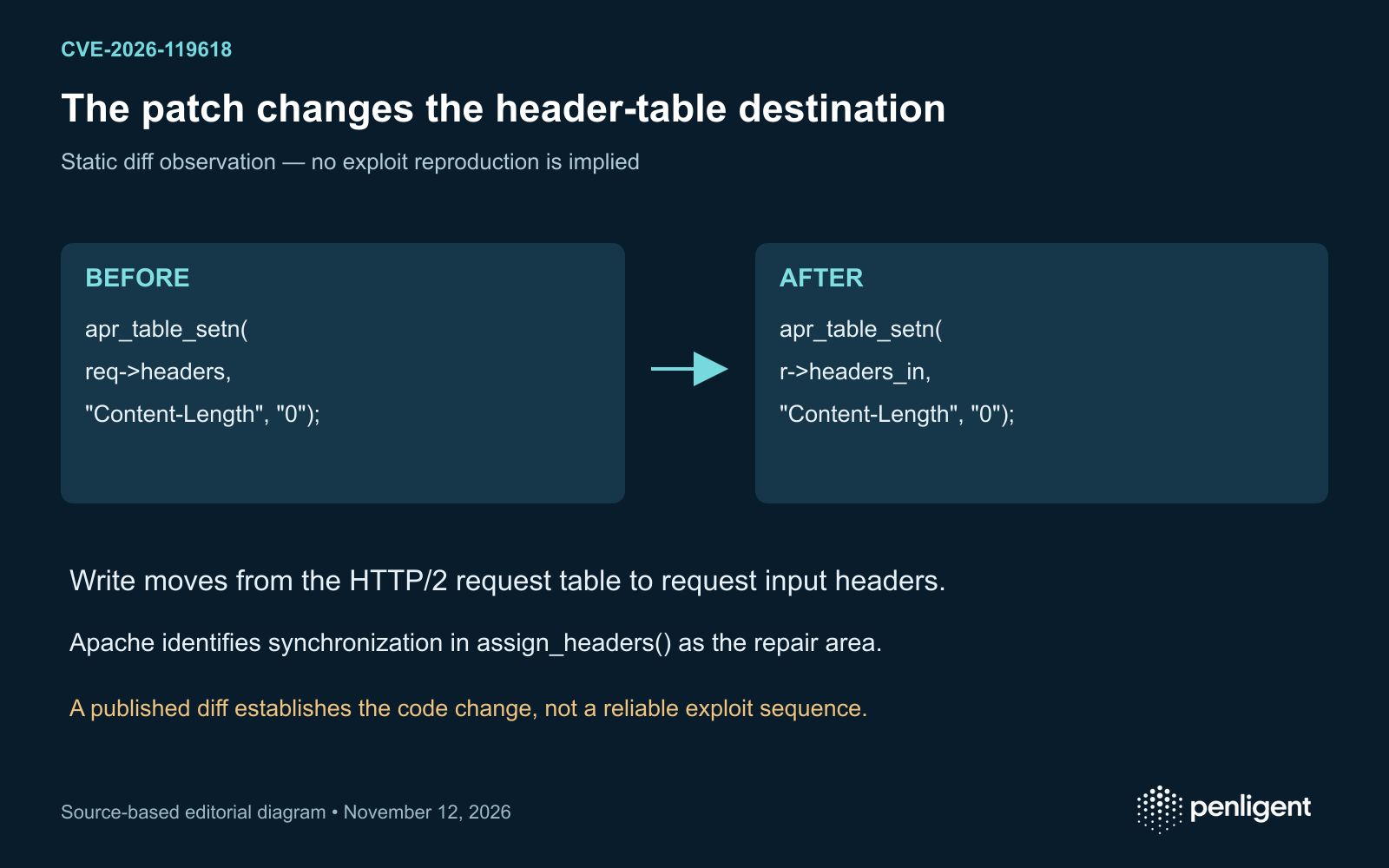
Apache links the advisory to commit 824beab. In modules/http2/h2_request.c, the change redirects a header-table write from the HTTP/2 request’s table to the Apache request record’s input-header table. The nearby comment describes the path where a content type exists but the end of the stream has already been seen:
// Before
apr_table_setn(req->headers, "Content-Length", "0");
// After
apr_table_setn(r->headers_in, "Content-Length", "0");
This is direct evidence of the changed write destination. Together with the advisory, it supports treating header ownership and synchronization as the relevant repair area. It does not establish a working exploit, a reliable request sequence, or the behavior of every build. This analysis inspects the published diff; it does not claim laboratory reproduction of code execution.
Make the version decision against the shipped component
| Deployment evidence | Decision |
|---|---|
| Upstream HTTP Server 2.4.55–2.4.70 with mod_http2 | Within Apache’s affected range; plan the 2.4.71 security update or a documented vendor fix. |
| Upstream HTTP Server 2.4.71 | Contains the upstream fix; confirm the running binary and loaded module match the updated installation. |
| A distribution package with an older upstream version | Use that distribution’s CVE status and exact package release to evaluate a backport; the banner alone is inconclusive. |
| A separately installed mod_h2 2.0.8–2.0.42 | Apache lists this module range separately. Verify the module supplier’s fix; do not infer a standalone fixed version from the httpd version. |
| No mod_http2 in the serving process | The vulnerable module path has not been identified there; retain evidence and inspect other instances and hops. |
Inspect the serving configuration without exploit traffic
On an authorized host, these Apache control commands display build, module, virtual-host and configuration information. Binary names and configuration locations vary by distribution; run the command that belongs to the serving instance, including inside its container when relevant.
apachectl -v
apachectl -M
apachectl -S
apachectl -t
Aramak için http2_module in the loaded-module output and inspect the applicable virtual hosts and included configuration for HTTP/2. Apache’s Protocols documentation describes the protocol selection, and its mod_http2 documentation explains the module. These commands inventory the configured instance; they do not prove that a separate service process uses the same binary.
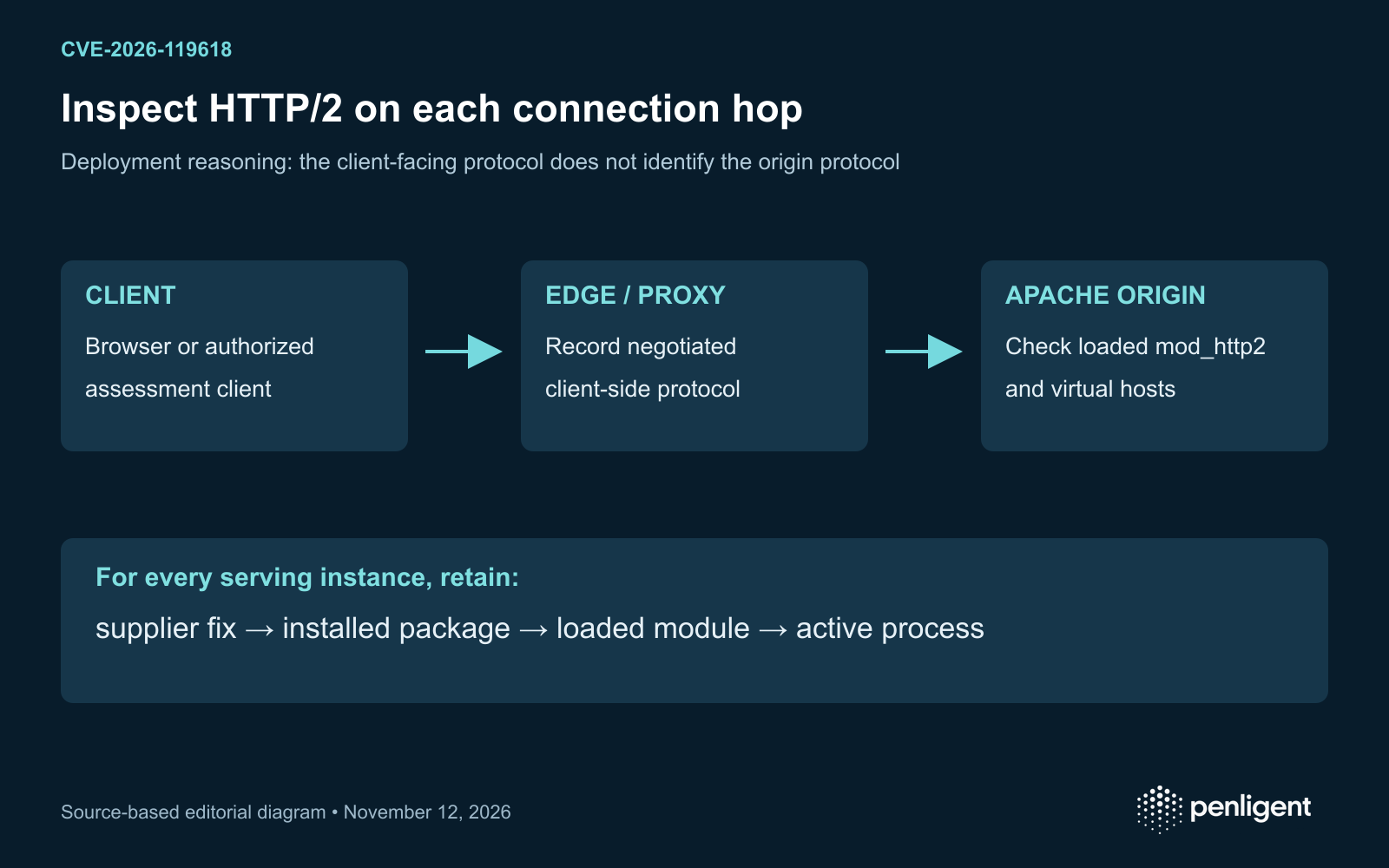
Trace each connection hop. Browser-to-CDN HTTP/2 does not tell you which protocol the CDN uses to the origin. Conversely, an HTTP/1.1 response observed from one hostname does not clear a different virtual host, listener, or internal proxy route. Record the origin protocol and reachable listeners for each in-scope Apache instance. Treat missing configuration visibility as unresolved exposure.
Mitigate and close with running-state evidence
Prioritize reachable affected HTTP/2 instances for the security update. If an emergency change restricts HTTP/2 exposure, verify all relevant virtual hosts and proxy hops, test required application behavior, and retain the patch task. Configuration containment addresses a path; it does not install the code fix.
For closure, retain the package or build identity, the supplier’s fix statement, loaded-module information, the serving process start time after the approved restart, and a normal application health check. Compare the active process with the updated files rather than assuming an installed package has replaced an already running process.
CVE-2023-44487, HTTP/2 Rapid Reset, is a separate issue. Sharing HTTP/2 as a protocol does not make its denial-of-service mitigations evidence that this header-processing memory-corruption flaw is fixed. The sources reviewed here establish the vulnerability and patch; they do not establish active exploitation of CVE-2026-119618.
The official Penligent 3.0 video below provides orientation to a general AI-assisted testing workflow. For this Apache assessment, retain the per-hop scope and running-process evidence described above. The video does not reproduce CVE-2026-119618 or certify an Apache patch.
Method: AI-assisted source review and static patch comparison, checked against Apache’s advisory and the CVE record on November 12, 2026. No exploit reproduction or production-system test is claimed.
 Turkish
 English
 German
 French
 Spanish
 Portuguese
 Japanese
 Korean
 Hindi
 Arabic
 Hebrew