
CVE-2026-126187 concerns unauthenticated remote code execution in three React Server Components transport packages: react-server-dom-webpack, react-server-dom-parcelve react-server-dom-turbopack. Bu React security advisory identifies an unusually specific condition involving responses that transport multiple typed arrays together with an attacker-controlled value. It recommends updating immediately.
Start with the server artifact, not the presence of React in a browser page. React explicitly excludes applications whose React code does not use a server and applications without a framework, bundler, or bundler plugin supporting React Server Components. Those exclusions matter when deciding which teams need an emergency deployment.
Match the transport package to its patched branch
| Affected branch | Fixed release named by React |
|---|---|
| 19.0.0 through 19.0.8 | 19.0.9 |
| 19.1.0 through 19.1.9 | 19.1.10 |
| 19.2.0 through 19.2.8 | 19.2.9 |
| 19.3.0 | 19.3.1 |
The table applies to each of the three named transport packages. The CVE record and React’s structured advisory package entries agree on these fixed releases. Updating only the top-level react package is insufficient evidence that a framework-managed transport dependency changed. Follow the framework’s compatible upgrade path and inspect the result.
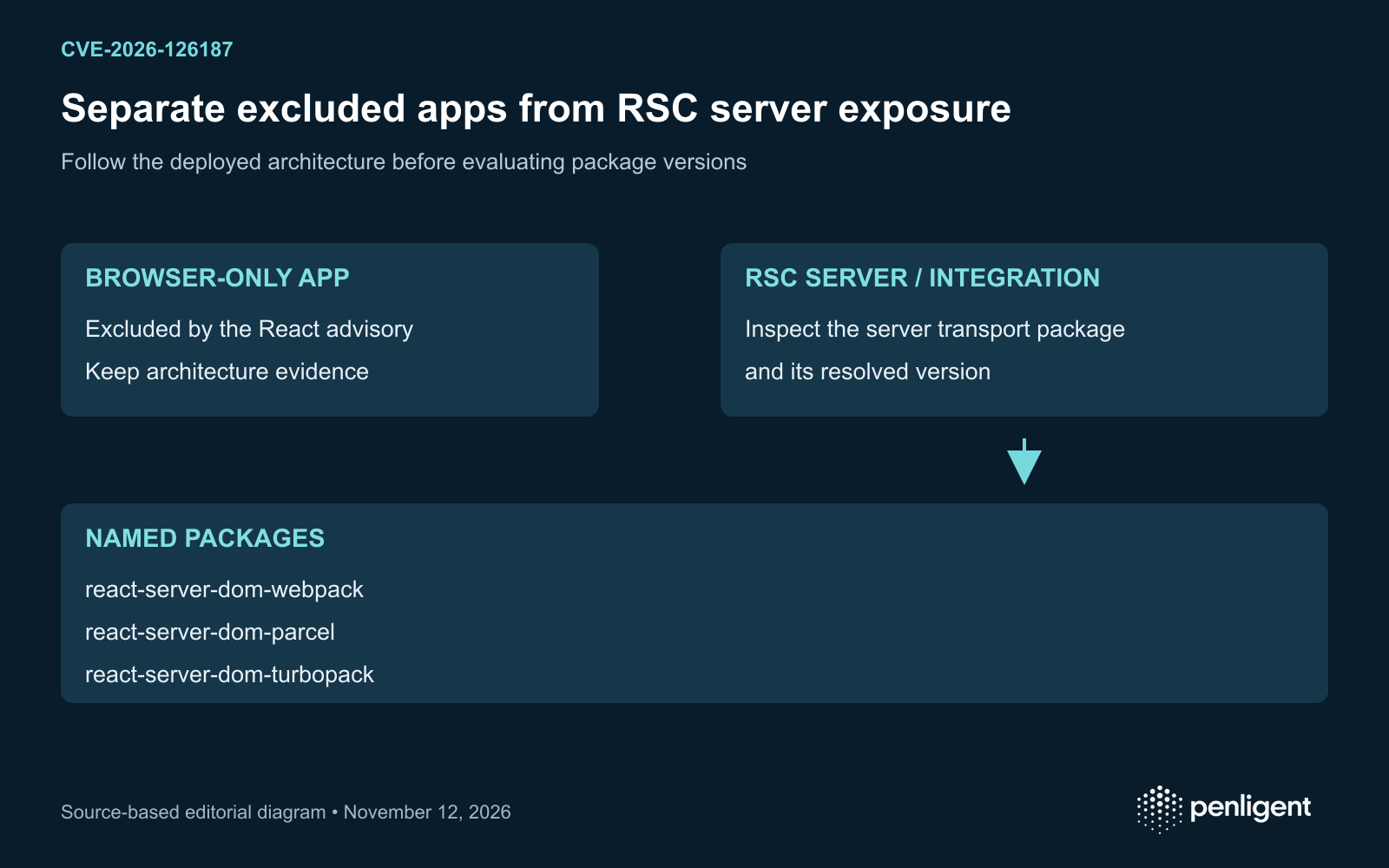
Use three exposure decisions
Browser-only React application: document that no React server is deployed for this application. The vendor’s exclusion applies to that architecture; do not create a server remediation task solely because a client bundle contains React.
Server deployment without RSC support: document the framework and build configuration establishing the exclusion. Server-side rendering by itself is not proof that this specific RSC transport is present. If the framework’s behavior is unclear, leave the assessment open while the application owner checks it.
RSC-capable server with an affected transport: prioritize a compatible patched release and rebuild. The advisory describes rare response conditions, but a team unable to rule those conditions out should not treat rarity as a compensating control. This is an assessment recommendation based on incomplete application visibility, not a claim that every RSC endpoint is exploitable.
Collect dependency evidence from the artifact that runs
In an authorized npm project or inspectable deployment directory, use a read-only dependency listing:
npm ls react-server-dom-webpack react-server-dom-parcel react-server-dom-turbopack --allRecord the package paths and resolved versions, including nested copies. The command may exit nonzero for an invalid dependency tree or missing packages; preserve its output and interpret the result. An empty result in a source checkout does not rule out dependencies embedded by a framework build, a different workspace, or a separate server image. Use the deployed artifact’s package inventory or SBOM when its layout does not expose an npm tree.
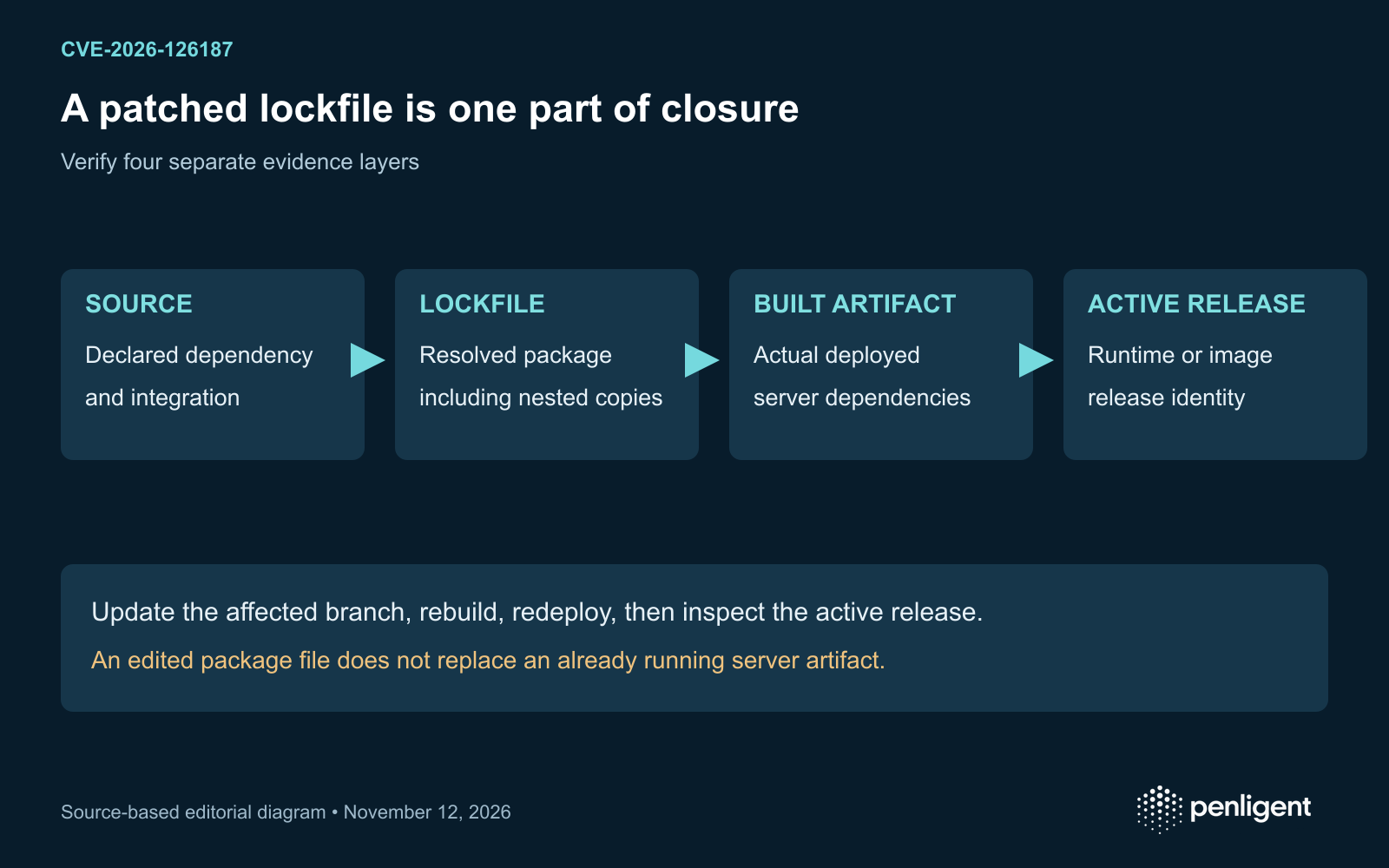
Keep source intent, build resolution, and active deployment separate. A modified manifest records intent. A refreshed lockfile records dependency resolution. The built image or release artifact shows what was shipped. The active release identifier and replacement of old instances establish what users reach. Check production services, preview deployments, background servers, and rollback artifacts within your authorized scope.
Resolve two inconsistencies before copying the advisory
The advisory prose spells one backport as 19.0.09. Its structured patched-version entries and the CVE affected ranges use 19.0.9; this article follows that corroborated spelling. Do not copy the extra zero into a package installation instruction.
The CVE record reports publication on November 10, 2026. The React advisory API exposes an earlier publication timestamp of October 14 and an update on November 10. These are different source metadata fields. The evidence does not establish that the complete current advisory text or CVE identifier was public on the earlier date, so this article does not present that timestamp as the vulnerability’s verified disclosure date.
What qualifies as remediation evidence
For each affected service, retain the resolved transport-package version, the compatible framework version, the build or image digest, deployment time, and confirmation that old instances were replaced. Exercise normal RSC-dependent application behavior after deployment. A successful page load is a compatibility check, not proof that an exploit failed or that every server is patched.
No exploit reproduction or in-the-wild exploitation finding is asserted here. The operational conclusion follows the maintained React advisory: identify the named packages in RSC-capable server deployments and install the corresponding security fix.
The official Penligent 3.0 video below illustrates a general testing workflow. For an authorized RSC application assessment, define the server artifact and evidence required before testing. The demonstration does not reproduce CVE-2026-126187 or establish dependency remediation.
Method: AI-assisted comparison of React’s advisory, its structured package data, and the CVE record on November 12, 2026. The assessment workflow is editorial analysis; no vulnerable application was tested.
 Turkish
 English
 German
 French
 Spanish
 Portuguese
 Japanese
 Korean
 Hindi
 Arabic
 Hebrew