
People searching for how to use an AI pentest tool to get an OpenAI bug bounty are usually mixing together three different problems. The first is scope. The second is tooling. The third is evidence. OpenAI’s public programs do reward discrete, high-value findings, but they do not reward vague curiosity, generic jailbreak screenshots, or broad attempts to push the platform until something strange happens. OpenAI’s public rules also make clear that users may not interfere with the service, circumvent rate limits or safety mitigations, or use the service for illegal, harmful, or abusive activity. That means the winning mindset is not “how do I make an AI tool attack OpenAI harder.” It is “how do I use AI to reduce noise, preserve context, and build one scoped, reproducible, material report that fits the public rules.” (OpenAI)
That distinction matters more in 2026 than it did even a year ago. OpenAI now has a long-running Security Bug Bounty program and, as of March 25, 2026, a separate public Safety Bug Bounty program aimed at AI-specific abuse and safety risks. The security lane is still about technical vulnerabilities. The safety lane now explicitly includes some agentic prompt injection, data exfiltration, proprietary-information exposure, and account or platform integrity issues. At the same time, OpenAI’s public materials still say that generic jailbreaks are out of scope for the safety program, and Bugcrowd’s public listing for the security program says issues tied only to model prompt and response content are strictly out of scope unless they carry additional directly verifiable security impact. If you do not separate those categories before you test, your AI assistant can help you write a polished report about the wrong thing. (OpenAI)
The hard truth is that AI pentest tools are useful here, but not in the way hype suggests. The best evidence from research and practitioner tools says AI helps most with sub-tasks: tool output interpretation, hypothesis generation, note compression, payload variation, response summarization, and report drafting. The same body of evidence also says full end-to-end autonomous penetration testing remains unreliable. PentestGPT’s original paper found real gains on sub-tasks and proposed architectural separation to reduce context loss. PentestEval, published in late 2025, tested 346 tasks across 12 realistic vulnerable scenarios and found generally weak performance overall, with end-to-end pipelines reaching only a 31 percent success rate and autonomous agents “failing almost entirely.” PortSwigger’s current Burp AI documentation takes the same position in practical product form: Burp AI is an on-demand assistant inside Repeater, and it is designed to augment expertise while the tester remains in control. (arXiv)
That is the frame that actually works for OpenAI bug bounty work. Use AI to shorten the boring middle. Do not use it as a substitute for judgment about scope, legality, or impact. Use it to structure evidence, compare states, summarize large traffic sets, cluster similar findings, and turn messy notes into a coherent report. Do not use it as permission to probe beyond the line that OpenAI’s public terms and bounty rules draw around allowed conduct. (OpenAI)
OpenAI bug bounty in 2026, security scope and safety scope are no longer the same thing
OpenAI’s public bug bounty story now has two lanes. The older lane is the Security Bug Bounty program, introduced in April 2023, with public rewards described by OpenAI as ranging from $200 for low-severity findings up to $20,000 for exceptional discoveries. The newer lane is the public Safety Bug Bounty, launched March 25, 2026, to accept AI-specific abuse and safety risks that may not fit the classic definition of a security vulnerability. OpenAI says reports may be rerouted between the two teams depending on scope and ownership. (OpenAI)
The public Safety Bug Bounty categories are unusually important because they tell researchers what OpenAI now considers a rewardable AI-specific problem. The official announcement names agentic risks including MCP, such as third-party prompt injection and data exfiltration when attacker-controlled text can reliably hijack a victim’s agent into harmful action or disclosure of sensitive information, with behavior reproducible at least 50 percent of the time. It also includes some agentic actions performed at scale on OpenAI’s website, some other potentially harmful agentic actions with plausible and material harm, exposure of OpenAI proprietary information related to reasoning, and account or platform integrity issues such as bypassing anti-automation controls, manipulating account trust signals, or evading suspensions or bans. OpenAI also says issues that allow access to features, data, or functionality beyond authorized permissions should go to the Security Bug Bounty instead. (OpenAI)
Just as important is what remains out of scope. OpenAI explicitly says generic jailbreaks are outside the public Safety Bug Bounty, except for some private campaigns focused on specific harm types. The same announcement adds that general content-policy bypasses without demonstrable safety or abuse impact are out of scope, and gives examples like jailbreaks that merely produce rude language or return information easily found by search engines. OpenAI’s CVE Assignment Policy separately says AI model safety vulnerabilities involving behavior or content, such as prompt jailbreaks, hallucinations, and policy bypasses, are not within scope of that CVE program. Public Bugcrowd snippets for the security program also say prompt and response content issues are strictly out of scope unless there is additional directly verifiable security impact. In plain English, “the model did something odd” is usually not enough; “the model, agent, or platform crossed a concrete security or safety boundary with reproducible harm” is the standard that matters. (OpenAI)
There is also a legal and operational layer that researchers ignore at their own expense. OpenAI’s Terms of Use say you may not use the services for illegal, harmful, or abusive activity, automatically or programmatically extract data or output, reverse engineer underlying components, or interfere with the service by circumventing rate limits, restrictions, protective measures, or safety mitigations. The usage policies add that OpenAI may withhold access where it reasonably believes it is necessary to protect the service or users. Those documents do not erase bounty safe harbor, but they do reinforce the need to stay strictly inside the published engagement and act in good faith. Bugcrowd’s public snippets for OpenAI’s pages also indicate safe harbor language for good-faith compliance with the program rules. (OpenAI)
One more distinction matters if you are the kind of researcher who thinks in CVEs. OpenAI became a CVE Numbering Authority in 2025 for vulnerabilities in its products and services, but the public policy says it generally will not reserve CVE IDs for server-side issues, and it will not assign CVEs for defense-in-depth fixes, misconfigurations, or informational findings. It also says model-behavior safety issues are out of scope for that CVE process. So if your mental model is “important bug equals CVE,” you will misread the outcome space. Some valuable bug bounty reports can be bounty-worthy but never become public CVEs. Some important AI safety findings may live in a different disclosure path altogether. OpenAI’s public policy also says it aims to acknowledge vulnerability reports within three business days and coordinate disclosure after mitigation is in place. (OpenAI)
The public matrix below is worth keeping in front of you while you work, because it prevents the most common category error in this space. (OpenAI)
| Issue pattern | Most likely lane | Why it belongs there | What evidence usually matters most | Erreur courante |
|---|---|---|---|---|
| Unauthorized access to features, data, or functionality | Security Bug Bounty | OpenAI explicitly routes beyond-authorized-permission issues to security | Clean reproduction, affected scope, authorization boundary, user impact | Filing it as a “jailbreak” because AI was involved somewhere |
| Third-party prompt injection that makes an agent exfiltrate sensitive data or take harmful action | Safety Bug Bounty | OpenAI explicitly names this category and requires reproducibility | Stable repro path, attacker-controlled content, observed harmful action or disclosure, success rate | Submitting a screenshot of weird model text with no actual action or exfiltration |
| Manipulation of account trust signals, anti-automation controls, or suspension evasion | Safety Bug Bounty | Account and platform integrity are explicitly named | Concrete before and after state, abuse potential, reproducibility, scope clarity | Describing speculative abuse without a verified platform effect |
| Generic rude or policy-violating output | Out of scope in public safety program | OpenAI says generic jailbreaks and low-harm policy bypasses are out of scope | Usually none, because no concrete security or safety boundary was crossed | Dressing a content issue up as “critical security” |
| Model hallucination without discrete security impact | Out of scope for CVE and usually not security bounty material | OpenAI’s CVE policy excludes model behavior issues | N/A unless tied to a concrete vulnerability or harmful agent action | Treating factual error as a security bug |
| Exposure of proprietary reasoning-related information or other proprietary information | Safety Bug Bounty | Explicitly listed on OpenAI’s public safety page | Clear evidence of disclosure, what was exposed, reproducibility, why it is not normal output | Confusing ordinary system behavior or public info with proprietary disclosure |
AI pentest tools help most in evidence and state, not in guessing
A lot of wasted bug bounty effort comes from asking AI to do the wrong job. The research record is consistent here. PentestGPT’s core contribution was not “the model hacks by itself.” It was to decompose the workflow so the model could do better at individual steps without losing the entire scenario to context drift. The paper says LLMs were strong at sub-tasks such as using testing tools, interpreting outputs, and proposing subsequent actions, while still struggling to maintain integrated understanding of the whole engagement. PentestEval sharpened that critique: current systems remain weak across the workflow as a whole, especially in long-horizon, end-to-end autonomy. (arXiv)
That is exactly why AI can still be extremely useful for bounty work. Bug bounty hunting is full of expensive context switches. You move between browser traces, headers, JSON blobs, screenshots, notes, account states, role differences, and hypotheses about impact. AI is good at compressing that material into something a human can reason about faster. Burp AI’s current product framing is unusually honest on this point. PortSwigger says it helps analyze HTTP messages, automate routine steps, explore payload variations, and capture insights, while the operator stays in control. That is not marketing modesty. It is the correct operating model. The moment you hand over legal, ethical, or scope judgment to an assistant, you are not saving time. You are creating a more fluent failure mode. (PortSwigger)
A second reason to keep AI in an assistant role is that OpenAI’s own agent-safety guidance now treats prompt injection as a realistic and evolving risk, not a toy problem. OpenAI’s March 2026 security write-up says the strongest real-world versions increasingly resemble social engineering more than simple prompt overrides. Its developer guidance says prompt injections are common and dangerous, can lead to private data exfiltration or misaligned actions via downstream tools, and warns builders not to place untrusted variables into developer messages because those messages have higher precedence. That is not just guidance for people building agents. It is a warning to researchers using AI helpers in bounty workflows. If you paste untrusted target content into a privileged prompt channel inside your own AI tool, you are creating a lab accident before you ever find a bug. (OpenAI)
The practical question is therefore not “which AI tool is smartest.” It is “which parts of the workflow deserve AI assistance, and which parts demand a human gate.” The answer below matches both the research literature and current practitioner tooling. (arXiv)
| Workflow job | Where AI helps | Where the human must stay primary | Failure mode if you over-trust AI |
|---|---|---|---|
| Traffic summarization | Compress repeated requests, cluster parameters, explain unusual fields | Decide whether the pattern is actually security-relevant | The assistant turns noise into a false narrative |
| Role and object mapping | Spot likely object references, identity edges, and repeated structures | Confirm whether differences reflect authorization flaws or normal business logic | AI labels normal multi-tenant behavior as an IDOR |
| Prompt injection triage | Organize attacker-controlled content, sinks, and observed agent actions | Judge whether harm is discrete, material, and actually in scope | The model confuses odd output with demonstrable exfiltration |
| Reproduction planning | Turn notes into clean steps, outline account setup, normalize timelines | Verify every step and every precondition | You submit a script that never actually reproduces the issue |
| Impact writing | Translate technical behavior into concise business or user impact | Keep claims proportional to evidence | The report becomes inflated and loses credibility |
| Report packaging | Draft titles, structure markdown, redact secrets, format appendices | Final review for accuracy, scope, and honesty | A polished report still gets closed because the core claim is wrong |
If that sounds less glamorous than the “AI hacker” pitch, that is because the useful shape of AI in offensive work is quieter than the hype. Penligent’s recent public writing makes this point in a way that lines up with the broader evidence. Its pages aimed at bug bounty researchers and AI pentest buyers repeatedly frame the category around state preservation, tool orchestration, verification, evidence, and operator control rather than one-prompt autonomy. That is the right shape for this kind of work. For a bounty researcher, a system that shortens the distance between raw artifacts and a reportable finding is far more valuable than a chatbot that sounds confident while hiding what it actually did. (Penligent)
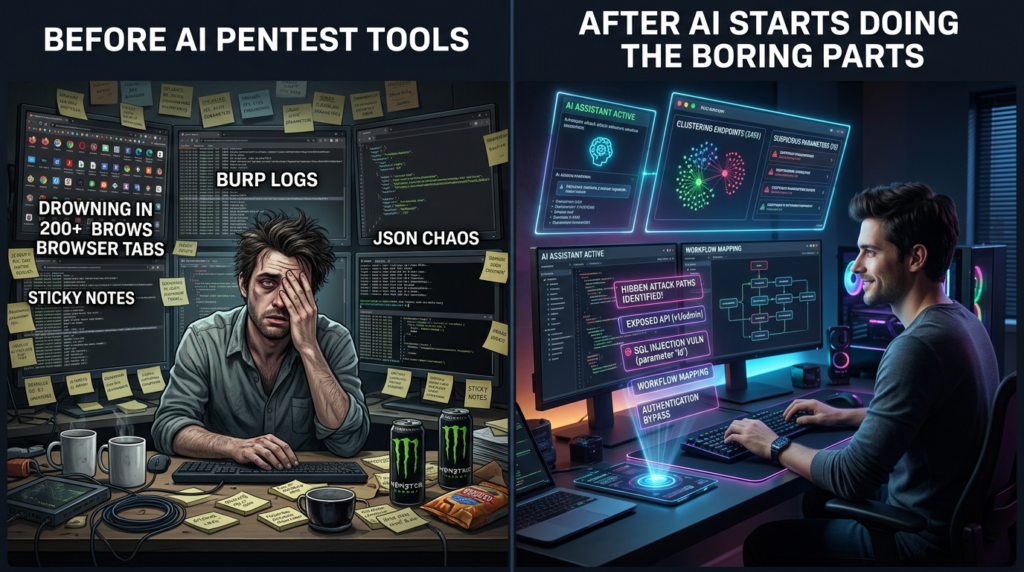
Building an AI pentest workflow for OpenAI bug bounty research starts with scope control
The first task in an OpenAI-oriented workflow is not scanning. It is classification. Before you let any AI assistant touch your notes, label the candidate issue as one of four things: likely security, likely safety, likely out of scope, or too early to classify. This sounds simple, but it changes everything downstream. If a behavior looks like classic access control drift, quota bypass with account effect, unintended feature access, or a platform integrity problem, it belongs on a security or platform track. If it looks like attacker-controlled content causing an agent to act or disclose data, it belongs on a safety track. If it is merely a strange completion, jailbreak-style roleplay, or embarrassing output without a concrete boundary crossing, it is probably out of scope for public bounty purposes. (OpenAI)
The second task is evidence hygiene. Many researchers now feed raw traffic, screenshots, and transcripts into AI systems for help. That can be useful, but it is also a great way to leak your own material or contaminate analysis. OpenAI’s developer safety guidance explicitly warns that prompt injections can cause private data leakage through downstream tool calls and that builders do not fully control what a model may choose to share with connected MCPs. The safe pattern is to keep an offline or tightly controlled evidence folder first, strip secrets before analysis, and only then pass the minimum needed context to an assistant. Even if your AI tool has good security controls, you still want local control over what leaves your machine. (Développeurs OpenAI)
The third task is to shift as much of your exploratory thinking as possible onto your own mirrors, mocks, and disposable test harnesses. This is where a lot of people misunderstand “AI pentest tool.” The right use is not to unleash autonomous exploration against a live target and hope the platform interprets that as research. The right use is to let AI help you stress-test your hypotheses in environments you control, then bring only the narrowest, cleanest reproduction back to the real target if the public rules clearly allow it. NIST’s penetration testing guidance remains old but relevant here: testing should be planned, controlled, and tied to analysis and mitigation rather than becoming free-form activity for its own sake. OpenAI’s own public rules reinforce that discipline by prohibiting interference, scraping, and bypass of protective measures outside allowed conduct. (Centre de ressources en sécurité informatique du NIST)
The fourth task is to keep a human approval gate before any action that touches a boundary you cannot easily reverse. AI can tell you that a behavior “probably indicates” access control drift or agent compromise. It cannot responsibly decide that you should take the next step against a real production service. The more capable the assistant, the more important that gate becomes. OpenAI’s prompt-injection defense article explicitly frames the problem as source and sink: untrusted external content becomes dangerous when paired with a sink such as a third-party transmission, link following, or tool action. That same framing is useful for researchers. Any time your next step involves a real sink, a human should stop, check scope, and decide whether to proceed. (OpenAI)
A very practical starting point is a local redaction pass. The code below is deliberately simple. It is not a scanner. It is a pre-processing utility for your own captured notes or requests, so that you can ask an AI assistant to summarize structure without exposing tokens, cookies, or obvious secrets. That is the kind of boring automation that actually saves time in bounty work.
import re
from pathlib import Path

SECRET_PATTERNS = [
    (re.compile(r'(?i)(authorization:\s*bearer\s+)[^\s]+'), r'\1REDACTED'),
    (re.compile(r'(?i)(api[-_ ]?key["\']?\s*[:=]\s*["\']?)[A-Za-z0-9_\-\.]+'), r'\1REDACTED'),
    (re.compile(r'(?i)(cookie:\s*)(.+)'), r'\1REDACTED'),
    (re.compile(r'(?i)(set-cookie:\s*)(.+)'), r'\1REDACTED'),
    (re.compile(r'(?i)(session[_-]?id["\']?\s*[:=]\s*["\']?)[A-Za-z0-9_\-\.]+'), r'\1REDACTED'),
]

def redact_text(text: str) -> str:
    redacted = text
    for pattern, replacement in SECRET_PATTERNS:
        redacted = pattern.sub(replacement, redacted)
    return redacted

def redact_file(input_path: str, output_path: str) -> None:
    raw = Path(input_path).read_text(encoding="utf-8", errors="ignore")
    Path(output_path).write_text(redact_text(raw), encoding="utf-8")

if __name__ == "__main__":
    redact_file("captured-request.txt", "captured-request.redacted.txt")
    print("Redacted copy written to captured-request.redacted.txt")
This sort of preprocessing is more relevant than it looks. It reduces the chance that your assistant sees credentials it does not need, makes it easier to share structured artifacts within a team, and forces you to think about the minimum evidence required to reason about the issue. That discipline pairs well with OpenAI’s own guidance on private-data leakage and with the general principle that AI helpers should receive the smallest amount of sensitive context needed for the task. (Développeurs OpenAI)
A second useful pattern is differential evidence on environments you control. Many valuable reports live or die on whether you can demonstrate that two roles, two sessions, or two object references produce a security-relevant difference rather than normal application variance. AI can help explain the difference, but you still want a machine-checkable comparison in your own files.
import json
from collections.abc import Mapping

def flatten(obj, prefix=""):
    items = {}
    if isinstance(obj, Mapping):
        for key, value in obj.items():
            next_prefix = f"{prefix}.{key}" if prefix else key
            items.update(flatten(value, next_prefix))
    elif isinstance(obj, list):
        for idx, value in enumerate(obj):
            next_prefix = f"{prefix}[{idx}]"
            items.update(flatten(value, next_prefix))
    else:
        items[prefix] = obj
    return items

def diff_json(path_a: str, path_b: str):
    a = json.load(open(path_a, "r", encoding="utf-8"))
    b = json.load(open(path_b, "r", encoding="utf-8"))

    flat_a = flatten(a)
    flat_b = flatten(b)

    all_keys = sorted(set(flat_a.keys()) | set(flat_b.keys()))
    for key in all_keys:
        va = flat_a.get(key, "<missing>")
        vb = flat_b.get(key, "<missing>")
        if va != vb:
            print(f"{key}\n  A: {va}\n  B: {vb}\n")

if __name__ == "__main__":
    diff_json("role-a-response.json", "role-b-response.json")
Used on your own lab target or an explicitly authorized test fixture, a tiny comparator like this helps separate real authorization drift from storytelling. It also gives you one of the most triage-friendly forms of evidence: the exact fields that changed, the sessions involved, and the state before and after. AI is strongest after this stage, when it can turn a verified diff into a readable explanation rather than inventing the diff for you. (Documents de Bugcrowd)
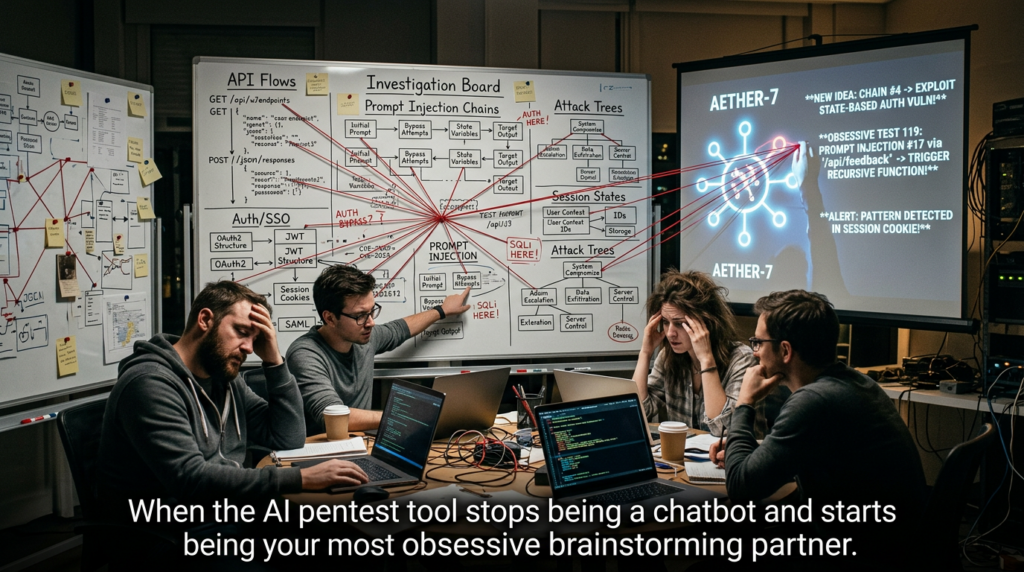
Capturing evidence that survives OpenAI bug bounty triage is the real job
If you have never watched a promising finding collapse in triage, it is tempting to think the hard part is detection. It often is not. The hard part is packaging the result so a reviewer can reproduce it, classify it, and understand why it matters without doing your thinking for you. Bugcrowd’s current researcher documentation is unusually explicit here. It says a report should explain where the bug was found, who it affects, how to reproduce it, the parameters involved, and include proof-of-concept supporting information such as logs, files, screenshots, or videos. It also says the report must at minimum include a descriptive title, the affected target, a technical severity choice, vulnerability details, and attachments. The docs warn that repeatedly testing outside approved scope can result in loss of access or platform privileges. (Documents de Bugcrowd)
That tells you what a good AI pentest workflow should optimize for. Not “finding everything.” Not “producing a beautiful markdown report.” It should optimize for creating a submission that maps neatly to the fields a triager already needs: concise title, precise target, reproducible walkthrough, evidence, and demonstrated impact. Bugcrowd’s report-writing guidance also stresses that the impact section is often where reports fail, because hunters copy generic severity text instead of explaining the actual consequence in the real context they tested. In other words, the report is weak not because the bug type is wrong, but because the impact story is lazy. AI can help a lot here, but only after you have concrete evidence. (Bugcrowd)
The best way to think about an OpenAI report is as a technical case file. Start with a title that names the condition, the target, and the outcome. “Access control issue” is not good enough. “Session state confusion in account settings allows access to subscription-only feature under free-tier account” is closer to the right shape. Bugcrowd’s own docs say the title should briefly explain the bug type, where it was found, and the overall impact, and they contrast descriptive titles with vague ones for exactly this reason. If your AI tool drafts titles for you, make it follow that rule. (Documents de Bugcrowd)
Then separate the report body into four layers. The first layer is overview: what the issue is, one paragraph, no drama. The second is walkthrough: exact steps, preconditions, accounts, states, and requests. The third is evidence: screenshots, clips, request and response pairs, timestamps, diff output, and anything needed to eliminate ambiguity. The fourth is demonstrated impact: not what similar bugs could do in theory, but what this one does here. Bugcrowd’s docs and guidance both converge on this structure even when they use slightly different labels. That convergence matters. It means your AI helper should be trained on structure, not persuasion. (Documents de Bugcrowd)
The single biggest upgrade most researchers can make is to explicitly separate observation from inference. Write, in substance, “Observed result: account A can trigger X under condition Y.” Then separately write, “Security interpretation: this appears to bypass boundary Z.” Then separately write, “Impact: the result would allow an attacker to do Q under these constraints.” AI systems are bad at keeping those layers apart unless you make them. They tend to collapse evidence and interpretation into one smooth narrative. Triagers do not reward smoothness. They reward reproducibility. (Documents de Bugcrowd)
Another underrated practice is to record stability honestly. OpenAI’s public Safety Bug Bounty page is explicit that at least one class of prompt-injection report must reproduce at least 50 percent of the time. Even when a category does not publish a threshold, stability matters. If your behavior occurs one time in ten and only after manual nudging, write that. Hiding instability does not make a report stronger. It makes it harder to validate. AI can help you summarize repeat-run outcomes, but it cannot change the underlying signal quality. (OpenAI)
A simple manifest format can help you keep this clean. The point is not bureaucracy. The point is to create a durable record that an AI assistant can summarize without silently losing the crucial facts.
title: "Describe the concrete issue and the concrete outcome"
target: "Specific product surface or asset"
lane: "security | safety | uncertain"
test_date_utc: "2026-03-26T18:30:00Z"
accounts:
  actor: "researcher-controlled account"
  victim: "researcher-controlled comparison account if applicable"
preconditions:
  - "List all setup requirements"
reproduction:
  - step: 1
    action: "What you did"
    artifact: "request-01.txt"
  - step: 2
    action: "What changed"
    artifact: "response-01.json"
evidence:
  screenshots:
    - "screen-01.png"
  diffs:
    - "role-diff.txt"
observed_result: "What actually happened"
expected_result: "What should have happened"
impact:
  users_affected: "Who is affected"
  boundary_crossed: "What boundary failed"
  constraints: "Any limits on exploitability"
stability:
  attempts: 5
  successes: 4
remediation_hint: "One sentence, if obvious"
A manifest like this also gives AI the right task. Instead of asking a model, “Do I have a critical bug,” you can ask, “Turn this manifest and these attachments into a concise report draft, preserving uncertainty and leaving severity language conservative.” That is a much safer and more productive use of AI. It keeps the assistant downstream of verified facts rather than upstream of them. (Documents de Bugcrowd)
One more operational detail matters: Bugcrowd’s docs say you cannot edit a submission after it is reported. That makes offline review and draft quality more important than many researchers realize. AI can help you pressure-test your own report before submission by asking for missing preconditions, ambiguous steps, or unsupported impact claims. Used that way, the model becomes a quality-control layer for your evidence rather than a hallucination engine for your conclusions. (Documents de Bugcrowd)
Why so many OpenAI bug bounty reports fail even when something interesting happened
The most common failure is filing the wrong category of issue. A generic jailbreak, a strange model answer, or a policy inconsistency may be interesting, but if it does not fit the current public bounty rules, it is not a strong public report. OpenAI’s public pages now make that distinction clearer than before. The Safety Bug Bounty wants AI-specific risks with plausible, material harm and actionable remediation paths, not just examples of the model being coaxed into saying something it should not. The CVE policy separately excludes model-behavior issues from that disclosure track. If you are using AI to brainstorm findings, you need a firm filter at this point or the assistant will happily help you overproduce out-of-scope material. (OpenAI)
The second common failure is substituting speculation for impact. Bugcrowd’s own reporting guidance emphasizes that the same bug type can have very different severity depending on the context and the actual consequence. In practice, a lot of AI-assisted reports read like this: “This could lead to full compromise, data theft, and platform abuse.” But the attached evidence only shows a quirky response or one weak state transition. The result is predictable. The report gets downgraded, closed as informational, or dismissed as not applicable. AI makes this worse if you let it generalize from a known vulnerability class to a stronger impact statement than your evidence supports. (Bugcrowd)
The third failure is weak reproducibility. OpenAI’s public safety program explicitly mentions reproducibility thresholds for at least one class of agentic issue. More broadly, triagers need a stable path to validation. If your issue depends on a race, a half-remembered prompt sequence, or an unstated account history, the problem is not that triage is unfair. The problem is that the report is incomplete. This is where AI can genuinely help by turning your raw notebook into a clean timeline and by forcing you to enumerate hidden preconditions. But again, it can only reveal what exists. It cannot create reproducibility out of thin air. (OpenAI)
The fourth failure is failing to distinguish target behavior from your own toolchain behavior. This is a growing problem in the AI era. Researchers increasingly use browser agents, MCP-connected assistants, local model servers, and automation wrappers. If something odd happens, you need to know whether the bug is in the target, in your own agent’s instruction handling, in a local extension, or in a connector that leaked or transformed data on the way. OpenAI’s own security writing frames agent compromise in terms of sources and sinks, and that framing is useful here too. A source may be attacker-controlled content, but the sink might be your own tool calling layer, not the target. If you cannot isolate that, you do not yet have a target report. (OpenAI)
The fifth failure is over-automation. OpenAI’s public terms explicitly prohibit automatically or programmatically extracting data or output and prohibit interfering with or disrupting the services. That does not mean you cannot use automation in your own analysis pipeline. It does mean you should be deeply cautious about any AI workflow that implicitly turns your local reasoning assistant into a live automation engine against a real service. Mature research in this space is not more reckless because better tools exist. It is more disciplined because the tools are more powerful. (OpenAI)
Relevant CVEs explain why your AI pentest tool can become the weak point
If you are serious about using AI in offensive-security workflows, you also need to secure the AI stack itself. This is not a side issue. It changes the quality of your research. A compromised or fragile toolchain can distort evidence, leak data, trigger unsafe actions, or create fake signals that you later misattribute to the target. Several recent CVEs in the AI tooling ecosystem are directly relevant to bug bounty researchers for that reason. (NVD)
Start with Langflow. NVD says CVE-2025-3248 affects Langflow versions prior to 1.3.0 and allows remote, unauthenticated code execution through code injection in the /api/v1/validate/code endpoint. That matters to bounty researchers because Langflow and similar workflow systems are often used as glue around agents, prompts, connectors, and testing flows. If your orchestration layer can be hit remotely, your “AI assistant” stops being a helper and becomes part of the attack surface. The mitigation lesson is obvious: do not expose workflow builders carelessly, patch them quickly, and do not confuse internal experimentation interfaces with safe public surfaces. (NVD)
Langflow is also a reminder that AI security failures often look embarrassingly traditional. The presence of a model does not magically create a new class of bug. Sometimes the problem is still unauthenticated code execution behind an endpoint that should never have been reachable or trusted. That is useful context when thinking about OpenAI bug bounty work. It pushes you away from magical thinking and back toward discrete boundaries, reachable interfaces, and concrete exploit conditions. The stronger your AI workflow becomes, the more old-fashioned your security discipline needs to be. (NVD)
Then there is Ollama. NVD says CVE-2025-0312 allows a malicious GGUF model file uploaded to Ollama versions up to 0.3.14 to crash the server via unchecked null pointer dereference, causing a denial of service. Later 2025 entries for Ollama also show authentication and token exposure issues in other parts of the ecosystem. Why should a bug bounty researcher care? Because a growing number of researchers use local or self-hosted models as sidecars for summarization, classification, or agent scaffolding. If that local inference layer is unstable or weakly secured, it can collapse in the middle of a test, corrupt your chain of evidence, or expose credentials and artifacts you intended to keep local. You do not need a dramatic RCE for the impact to be real. Availability and isolation matter in research environments too. (NVD)
The lesson from Ollama is not “do not self-host.” It is “treat self-hosted AI infrastructure like real infrastructure.” Patch it. Restrict who can reach it. Be careful about what files it accepts. Separate sensitive projects. And if you are letting an AI pentest tool ship data to local helpers, understand that those helpers are now in your trust chain. That matters even more when your research touches prompts, transcripts, or evidence that may later become a coordinated disclosure. (NVD)
CVE-2025-53098 in Roo Code is one of the clearest illustrations of the prompt-to-config-to-exec problem that now defines much of agent security. NVD says the Roo Code agent stored project-specific MCP configuration in .roo/mcp.json, that the configuration format allowed arbitrary command execution, and that before version 3.20.3 an attacker could craft a prompt asking the agent to write a malicious command to that configuration file. NVD further notes that arbitrary command execution required the user to have MCP enabled and to have opted into auto-approved file writes. This is not just a niche IDE story. It is the exact kind of chain bounty researchers should internalize: attacker-controlled content, privileged write path, dangerous execution bridge, conditional but meaningful impact. (NVD)
Why is Roo Code relevant to OpenAI bug bounty work specifically? Because OpenAI’s own 2026 public Safety Bug Bounty now explicitly includes some agentic prompt injection and MCP-related risk categories. The broader ecosystem is converging on the same reality: the high-value issues are no longer only “the model said the wrong thing.” They are “untrusted content gained influence over a tool path with real authority.” Roo Code is a concrete example of that pattern outside OpenAI. It helps researchers think more clearly about what a real agentic risk looks like and what evidence would be needed to report one responsibly. (OpenAI)
CVE-2025-34072 in Anthropic’s deprecated Slack MCP Server is equally instructive. NVD says untrusted data could manipulate the agent into generating attacker-crafted hyperlinks that embed sensitive data, after which Slack’s preview bots would issue outbound requests to attacker-controlled URLs, leading to zero-click exfiltration. This is an excellent case study because it captures the difference between a language problem and a system problem. The model did not need to be fully “compromised” in a theatrical sense. It only needed to pass through untrusted content, create an output in the wrong shape, and rely on an external platform behavior that converted that output into exfiltration. That is exactly the type of reasoning good AI pentest work should help you do: identify sinks, identify automations, and identify where authority leaks across layers. (NVD)
CVE-2025-31363 in Mattermost’s AI plugin tells a similar story from another angle. NVD says the product failed to restrict what domains the LLM could request upstream, allowing an authenticated user to exfiltrate data from an arbitrary server accessible to the victim via prompt injection in the Jira tool. Again, the relevant lesson is not the vendor. It is the shape of the defect. A connected assistant was given network reach and insufficient domain restriction, and untrusted content could influence where data went. That is a helpful mental model for evaluating whether an AI-adjacent OpenAI report belongs in the public Safety Bug Bounty lane. You are not looking for “weird words.” You are looking for a real path from influence to action to harm. (NVD)
The table below captures why these CVEs matter to anyone using AI pentest tools in a bounty workflow. (NVD)
| CVE | Affected component | Why it matters to bounty researchers | Key precondition | Atténuation pratique |
|---|---|---|---|---|
| CVE-2025-3248 | Langflow | Your workflow/orchestration layer can become the vulnerability instead of your target | Exposed vulnerable endpoint on versions before 1.3.0 | Patch, avoid exposing workflow builders, restrict access |
| CVE-2025-0312 | Ollama | Local sidecar models can become unstable or exploitable, damaging evidence handling | Malicious GGUF upload to vulnerable server | Patch, isolate model hosts, control file intake |
| CVE-2025-53098 | Roo Code | Prompt injection can cross into config writes and then command execution | Prompt influence plus MCP enabled and auto-approved writes | Patch, disable dangerous auto-approval, protect config paths |
| CVE-2025-34072 | Slack MCP Server | Seemingly harmless generated output can become zero-click exfiltration through platform automations | Untrusted data processed by agent and link unfurling behavior | Limit automations, sanitize outputs, reduce outbound sinks |
| CVE-2025-31363 | Mattermost AI plugin | Domain controls and connector boundaries are central to AI exfiltration risk | Authenticated user plus prompt injection path in tool workflow | Strict domain allowlists, tool-level egress controls |
This is also where Penligent’s public positioning on verification and evidence is more useful than purely theatrical autonomy claims. A serious AI pentest platform should help you keep tool boundaries visible, preserve artifacts, and require human review when the workflow approaches a meaningful sink. That is the right design instinct whether you are using Penligent, Burp AI, a local agent stack, or your own scripts. The operational goal is traceability. If your assistant cannot show what it saw, what it changed, and what evidence it produced, it is a poor fit for high-quality bug bounty work. (Penligent)
Choosing an AI pentest tool for OpenAI bug bounty work means choosing control, not just model quality
A lot of “best AI pentest tool” discussions still focus too heavily on the model. That is understandable, but incomplete. The model matters. The workflow matters more. OpenAI’s own practical guide to building agents describes modern agent systems in terms of models, tools, state, and orchestration. Its developer safety guidance emphasizes prompt-injection risks, tool-calling caution, and the danger of mixing untrusted content into privileged channels. The best current pentest tooling research says the same thing from the offensive side: the hard part is not generating one clever idea, but maintaining state, controlling tools, and preserving evidence across a multi-step process. (Développeurs OpenAI)
For bounty work, that means your evaluation criteria should be practical. Can the tool keep separate notes for separate hypotheses, or does it blend them together? Can it preserve original requests, responses, screenshots, and diffs, or does it only offer narrative summaries? Can you redact or keep analysis local before sending context to a remote model? Can you review or edit the agent’s proposed next step before any live action occurs? Can it help you generate a report that maps directly to Bugcrowd’s expected fields? These questions matter more than whether the assistant can sound like an expert for five paragraphs. (Documents de Bugcrowd)
This is why the most useful recent Penligent pages are not the ones making grand claims about AI replacing experts. The stronger ones are the pages that discuss AI pentest tools, bug bounty software, and pentest-GPT-style workflows in terms of preserving state, turning raw signals into verified findings, and helping the operator move from target modeling to reproducible evidence. Whether you choose Penligent or not, that is the standard to use: does the tool make your evidence sharper, your scope discipline stronger, and your report easier to verify. If the answer is no, it is not the right tool for OpenAI-facing research. (Penligent)
A researcher who cares about OpenAI bug bounty quality should usually prefer a system that is a little less autonomous and a lot more inspectable. That preference now has public support from both the research side and the vendor side. PentestEval says autonomy is still brittle. Burp AI says the operator stays in control. OpenAI’s own agent guidance says risk sits in tool use, data leakage, and prompt injection boundaries. Taken together, those sources point to one conclusion: the right AI pentest tool is the one that shortens analysis time without obscuring action and evidence. (arXiv)
What not to do if you want a valid OpenAI bug bounty report
Do not confuse a generic jailbreak with a public bounty-worthy security issue. OpenAI’s public safety page says generic jailbreaks and low-harm content-policy bypasses are out of scope. Its CVE policy separately says model-behavior issues are not in that disclosure scope. If the issue is fundamentally “I made the model say something it should not,” your first job is to determine whether there is any discrete, reproducible safety or security consequence beyond the output itself. If there is not, public bounty status is unlikely. (OpenAI)
Do not treat programmatic extraction, stress testing, or bypass attempts as harmless exploration. OpenAI’s public Terms of Use explicitly prohibit automatically or programmatically extracting data or output and prohibit interfering with the services, including circumventing rate limits, restrictions, protective measures, or safety mitigations. If your AI pentest workflow silently nudges you toward those behaviors, the workflow is misaligned with the target from the start. (OpenAI)
Do not paste raw, unreviewed target material into privileged prompt channels inside your own tools. OpenAI’s developer guidance specifically warns against putting untrusted variables in developer messages, because those channels carry higher authority and give attackers maximal leverage if contaminated. This is not just advice for builders. It is also advice for researchers using AI assistants to inspect web pages, messages, files, or traffic. (Développeurs OpenAI)
Do not let AI write your impact section unsupervised. Bugcrowd’s own report-writing guidance says impact is where many reports go wrong, because the same technical bug can have very different real-world severity depending on the context. AI is excellent at producing generic impact prose. That is precisely why you should be careful. Generic impact prose is one of the easiest ways to make a valid technical finding look immature. (Bugcrowd)
Do not submit early. Bugcrowd’s docs say submissions cannot be edited after reporting, and they strongly recommend illustrative evidence including screenshots, videos, scripts, or logs. If the finding is still a hypothesis, keep it in your notebook. Once you can describe the boundary crossed, reproduce it cleanly, and document the actual effect, then let AI help you package it. Not before. (Documents de Bugcrowd)
The mature way to use AI pentest tools for OpenAI bug bounty work is to shrink uncertainty
That is the real answer to the search phrase. The mature use of AI pentest tools in OpenAI bug bounty research is not to widen your attack surface. It is to narrow your uncertainty. You use AI to summarize traffic you already captured, compare states you already measured, organize evidence you already verified, and draft a report around facts you already believe. You do not use it to guess what might be in scope, invent impact, or decide that a live service deserves broader probing. (arXiv)
The public rules now support that disciplined approach. OpenAI’s safety and security pages make the reporting lanes clearer. Its CVE policy explains what kinds of issues do and do not fit public technical disclosure. Its prompt-injection and agent-safety material shows where modern AI systems are actually weak. NIST still provides the controlled-testing mindset. OWASP still provides broad test coverage maps for web systems and newer agentic guidance for AI-connected ones. And the current pentest-tooling literature makes the limit of automation impossible to ignore. This is a very good environment for careful researchers. It is a poor environment for people hoping an AI tool will replace method. (OpenAI)
When your workflow is correct, the deliverable becomes simple to describe. You have a candidate issue that clearly belongs in either the security or safety lane. You have a narrow, reproducible set of steps. You have evidence that preserves raw artifacts. You have an impact statement that is proportional to what you actually observed. And you have not forced AI to do the one thing it is still worst at in this field, which is pretending uncertainty has already been resolved. That is how AI pentest tools help you earn respect in bounty work. Sometimes it is also how they help you earn a bounty. (OpenAI)
The most practical value of an AI pentest tool is not that it “finds bugs by itself,” but that it compresses the amount of time a researcher spends moving between raw inputs and testable conclusions. In real bug bounty work, a large share of time disappears into repetitive tasks such as reading long HTTP traces, summarizing JavaScript behavior, comparing role-based responses, organizing notes, and rewriting rough observations into something structured enough to validate. AI is well suited to that middle layer. It can reduce the time required to interpret noisy artifacts, surface patterns that deserve a second look, and turn scattered findings into a cleaner sequence of follow-up checks. That kind of acceleration matters because it lets the researcher spend more energy on the parts that still require judgment, such as scope decisions, exploitability analysis, and impact verification.
AI pentest tools are also useful because they widen the search space of ideas. Experienced testers already know that many good findings come from asking slightly better questions: what assumptions does this workflow make, what state changes are trusted too early, what hidden object references are exposed, what happens when content from one context is consumed by another. AI can help generate more of those questions, especially when a target has a large interface surface or a complex multi-step flow. It can suggest alternative abuse paths, propose edge cases a human might skip on a tired pass, and connect observations across pages, requests, and tool outputs that would otherwise remain isolated. That does not replace the researcher’s judgment, but it does increase the odds of discovering a more original and better-supported line of testing before time runs out.

Further reading on OpenAI bug bounty and AI pentest tools
For the public rules and program structure, start with OpenAI’s Security Bug Bounty announcement, OpenAI’s Safety Bug Bounty announcement, the Coordinated Vulnerability Disclosure policy, and OpenAI’s CVE Assignment Policy. These are the pages that define the current public lanes, scope language, and disclosure expectations. (OpenAI)
For AI-specific security reasoning, read OpenAI’s Designing AI agents to resist prompt injection and the OpenAI developer documentation on Safety in building agents. Those pages explain why prompt injection should be analyzed as a system problem involving authority, sinks, and tool boundaries, not just as a prompt-string problem. (OpenAI)
For testing methodology and realistic expectations, the best pair is still NIST SP 800-115 for controlled testing discipline and the combination of PentestGPT and PentestEval for the current state of LLM-assisted pentesting. PortSwigger’s Burp AI documentation is also valuable because it shows how a mature offensive tool vendor frames AI as an assistant rather than a replacement. (Centre de ressources en sécurité informatique du NIST)
For adjacent frameworks, OWASP’s Web Security Testing Guide remains the strongest public map for classic web testing coverage, while OWASP’s newer agentic and LLM security resources help translate AI-connected behavior into concrete risk categories. MITRE ATLAS is also useful for thinking about AI attack behaviors once your analysis moves beyond ordinary web flaws. (Fondation OWASP)
For relevant Penligent reading that naturally extends this topic, the most useful public pages are Penligent’s AI Pentest Tool article, Bug Bounty Hunter Software in 2026, Pentest GPT in 2026, and AI in Cyber Security. Those pages are relevant here because they focus on workflow shape, operator control, evidence, and the limits of autonomy rather than pretending AI makes method optional. The Penligent homepage is the right place to look only after those articles, because the product question comes after the workflow question, not before it. (Penligent)

 French
  English
  German
  Spanish
  Portuguese
  Japanese
  Korean
  Hindi
Hindi  Arabic
  Turkish
  Hebrew