
The 2026 FIFA World Cup has not become a cybersecurity story because the tournament’s core infrastructure has been publicly confirmed as compromised. The real story is more useful for defenders: attackers are already building around the event.
The tournament runs from June 11 to July 19, 2026, with 48 teams, 104 matches, and 16 host cities across the United States, Canada, and Mexico, according to the Canadian Centre for Cyber Security’s World Cup threat bulletin. That scale creates more than a sports calendar. It creates a temporary digital economy made of ticketing, resale, hospitality, airlines, hotels, short-term rentals, sponsor campaigns, media portals, mobile apps, payment flows, gambling offers, recruiting lures, fan zones, public Wi-Fi, social media, and local government services.
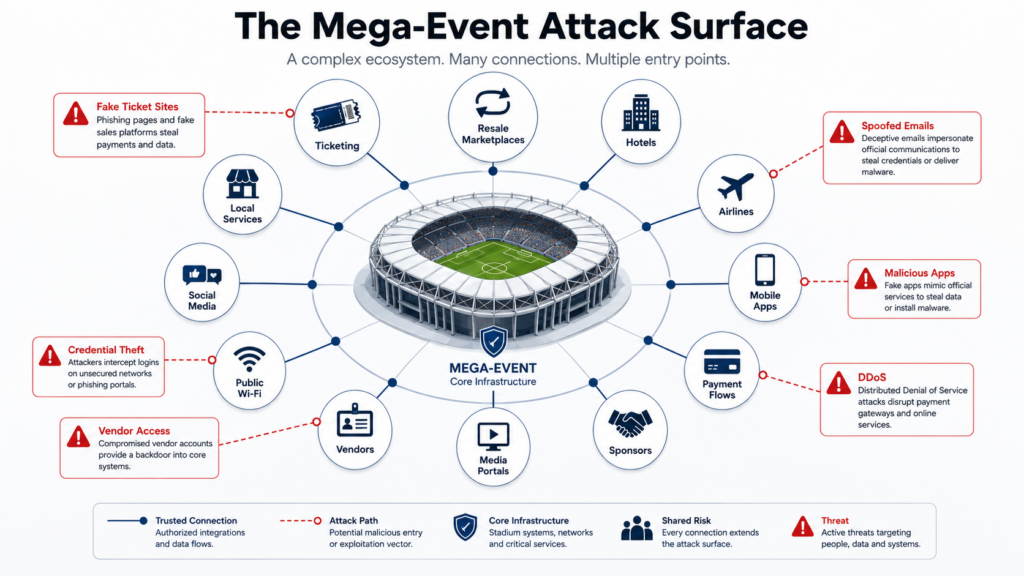
That is why World Cup 2026 cyber threats should not be reduced to a single question such as “Was FIFA hacked?” A mega-event is an attack surface. Some parts are official. Some are adjacent. Some are third-party. Some are temporary. Some are operated under intense time pressure by organizations that normally do not behave like high-volume e-commerce platforms.
The most visible risk right now is fraud. The FBI’s Internet Crime Complaint Center has warned that threat actors are spoofing FIFA websites to collect personal information, sell fake World Cup tickets and hospitality products, and potentially support other malicious activity. The FBI specifically describes typo-squatting and alternative top-level domains as part of the pattern, including domains that imitate legitimate FIFA web properties with minor spelling changes or fake subdomain-like structures. FBI IC3 advisory
FIFA’s own ticketing support page gives the consumer version of the same warning: tickets purchased outside FIFA.com/tickets are considered unofficial, may involve fraud or scams, and may be invalid or cancelled without notice. FIFA ticketing support
Security companies are seeing the surrounding infrastructure form early. FortiGuard Labs reported that more than 13,000 new FIFA World Cup 2026-themed domains were registered between January and May 2026, with about 8.8% identified as malicious or suspicious through pattern analysis and scam activity. The categories include fake ticketing sites, resale scams, fake merchandise stores, malicious betting and streaming applications, third-party APK risks, social media impersonation, fake job postings, cryptocurrency scams, and credential exposure tied to stealer malware and breach data. מעבדות FortiGuard
Recorded Future has reached a similar directional conclusion from a threat-intelligence perspective: World Cup demand and branding are likely to drive purchase scams, fake FIFA-branded stores, spoofed FIFA and host-city domains, AI-generated phishing, smishing, social engineering, malware delivery, fraud, and possible espionage or disruptive activity against high-value people and organizations around the event. עתיד מוקלט
That combination is what makes the World Cup a useful case study for security engineers. It is not just a consumer scam wave. It is a test of whether organizations can handle event-driven attack surface expansion before the opening match.
The World Cup attack surface is not one system
A normal security review might start with a domain, a set of IP ranges, a cloud account, or a product boundary. World Cup 2026 cyber threats do not fit cleanly into that model.
The event touches many loosely connected systems:
| Attack surface | Typical users | Likely abuse pattern | Security impact |
|---|---|---|---|
| Official ticketing and resale flows | Fans, sponsors, travel groups | Lookalike domains, account takeover, fake payment pages | Fraud, PII theft, invalid tickets, brand damage |
| Hospitality and travel portals | Fans, VIPs, delegations, media | Fake hotel offers, booking phishing, invoice fraud | Payment loss, identity theft, business email compromise |
| Sponsor and supplier domains | Customers, procurement teams, partners | Email spoofing, fake promotions, fake support messages | Credential theft, invoice redirection, customer fraud |
| Mobile apps and APKs | Fans seeking tickets, streams, betting, transit | Sideloaded malware, fake updates, accessibility abuse | Banking theft, credential theft, device compromise |
| Streaming and broadcaster services | Viewers, broadcasters, advertisers | DDoS, fake streams, malware subscriptions | Availability loss, fraud, reputational impact |
| Venue and fan-zone systems | Staff, attendees, vendors | Wi-Fi impersonation, signage compromise, QR-code abuse | Disruption, misinformation, unsafe crowd behavior |
| Remote access and vendor tools | Contractors, IT teams, logistics providers | Exploited VPNs, stolen sessions, exposed admin panels | Initial access, ransomware, data theft |
| Social media and advertising | Fans, brands, local authorities | Fake accounts, paid scam ads, deepfake promotions | Fraud amplification, disinformation, brand confusion |
The key defender mistake is treating these as separate problems. Attackers do not have to compromise “the World Cup” in a formal sense. They can compromise a reseller account, create a fake ticketing portal, spoof a hotel partner, abuse an exposed supplier VPN, or run paid ads to a phishing page that looks official for long enough to capture credentials.
The event’s value comes from compression. Fans are rushing to buy. Travelers are comparing prices. Businesses are onboarding temporary vendors. Media teams are publishing live updates. Payment processors are handling unusual flows. Security teams are under pressure not to block legitimate traffic. That is the exact environment in which social engineering, credential reuse, and weak identity controls become more valuable.
What the major threat reports agree on
The strongest public reporting does not all use the same language, but the pattern is consistent.
| מקור | What it says | Practical reading for defenders |
|---|---|---|
| FBI IC3 | Threat actors are spoofing FIFA websites to collect PII, sell fake tickets and hospitality products, and possibly facilitate other malicious activity. | Brand impersonation and fake ticketing are active enough to justify public warning. |
| FIFA ticketing support | Tickets from sources other than FIFA.com/tickets are unofficial and may involve fraud, scams, invalid tickets, or cancellation. | Security and customer support teams should anchor user education around official purchase paths. |
| Canadian Centre for Cyber Security | Cybercriminals will almost certainly exploit public engagement; ransomware, DDoS, defacement, state activity, and AI-driven disinformation are plausible risks. | Treat the tournament as a broad ecosystem risk, not just a website fraud issue. |
| מעבדות FortiGuard | More than 13,000 World Cup-themed domains were registered from January to May 2026, with about 8.8% categorized as malicious or suspicious. | Domain monitoring, takedown workflows, and brand protection need to be live before peak demand. |
| Check Point | Threat actors have been pre-positioning around finance, travel and hospitality, and gambling. | Fraud teams, SOC teams, and business units need a shared event risk model. |
| Proofpoint | More than one-third of analyzed official World Cup partner domains lacked full DMARC reject enforcement. | Spoofed email risk is not limited to FIFA. Sponsor and supplier identity matters. |
| עתיד מוקלט | AI-generated content can scale phishing, smishing, impersonation, and social engineering around World Cup demand. | Manual review alone will not keep up with high-volume, multilingual lures. |
| רויטרס | Security planners are preparing for drones as a complex threat to stadiums, fan zones, hotels, training sites, and transit routes. | Physical and digital security teams need shared incident workflows for hybrid threats. |
The disagreement is mostly about scope and confidence. Some sources focus on observed fraud infrastructure. Others assess likely future activity such as ransomware, hacktivism, disinformation, and state-linked disruption. That distinction matters. Observed fake domains are not the same as confirmed ransomware against tournament infrastructure. A careful security article should not collapse them into one sensational claim.
The safer statement is this: World Cup 2026 cyber threats are already visible at the fraud, impersonation, and infrastructure-prepositioning layer, while broader risks such as ransomware, DDoS, defacement, disinformation, and espionage remain credible planning scenarios for organizations connected to the event.
Fake FIFA sites are the cleanest signal
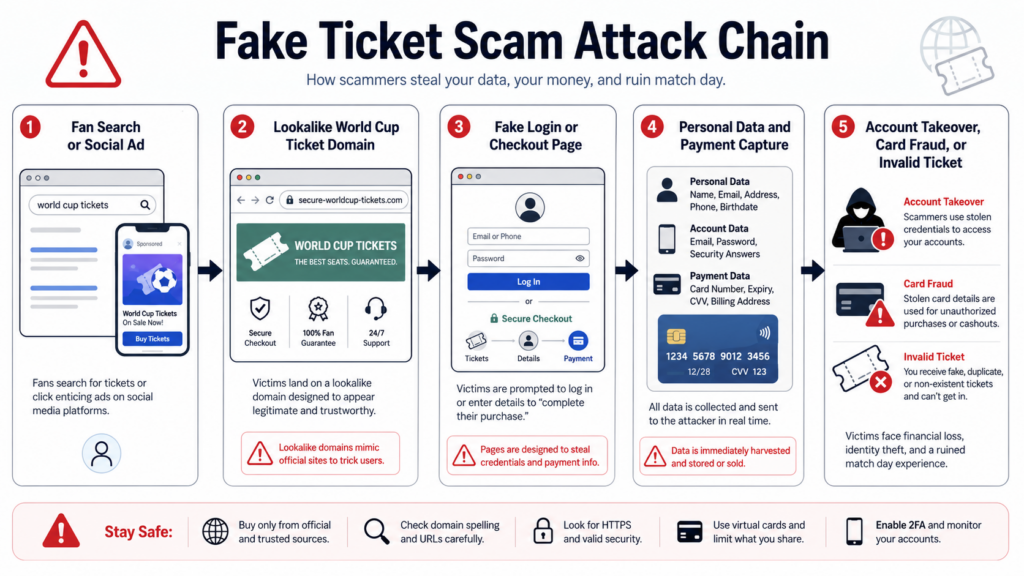
The fake-site problem is easy to understand because it follows a familiar pattern.
A fan searches for tickets, hospitality, resale access, a team package, a livestream, or a job. The attacker places a domain that looks close enough to the real thing. The fake site uses FIFA-related branding, event language, urgency, countdown timers, discounts, or “limited allocation” messaging. The victim enters credentials, personal information, payment card details, passport information, or account recovery data. The attacker monetizes the result through payment fraud, account takeover, identity theft, ticket resale, or further phishing.
The FBI’s advisory highlights two common domain-abuse patterns:
- Minor misspellings of a legitimate domain.
- Alternative top-level domains or fake subdomain-like names that create a false sense of legitimacy.
The threat is not only that a victim loses money on a fake ticket. If a victim enters a FIFA account password and reuses that password elsewhere, the attack can become credential stuffing. If the fake checkout collects home address, phone number, email address, and payment data, the attack can become identity fraud. If the victim is an employee of a sponsor, hotel, broadcaster, airline, payment processor, or local organizer, the same lure can become a corporate initial-access attempt.
Defensive domain monitoring
Brand-protection vendors can do this at scale, but many security teams can build a useful first layer with open-source tooling and strict process.
A simple defensive workflow:
- Define protected strings such as
fifa,worldcup,worldcup2026, host city names, sponsor brand names, and official campaign names. - Monitor newly registered domains and certificate transparency logs.
- Score domains by similarity, age, registrar, hosting ASN, TLS certificate age, and whether they host login or checkout pages.
- Review risky domains quickly enough to request takedown before high-traffic match windows.
- Feed confirmed domains into DNS filtering, secure web gateway, EDR, SIEM, fraud tooling, customer support scripts, and abuse reporting channels.
A defensive analyst can use dnstwist to generate likely lookalikes for owned domains and compare them against live registrations. This should only be used for authorized brand monitoring and defensive discovery.
# Defensive lookalike-domain monitoring for an owned brand domain
# Install: pipx install dnstwist
dnstwist --registered --format csv fifa.com > fifa_lookalikes.csv

# Review domains with active DNS
awk -F, 'NR==1 || $0 ~ /registered/' fifa_lookalikes.csv | head -50
For organizations connected to the tournament, the same process should be applied to sponsor domains, ticketing subdomains, hospitality portals, payment domains, and customer-support domains. Attackers often impersonate the weakest trusted brand, not the best-defended one.
Detecting suspicious outbound traffic
A SOC can flag user traffic to domains containing tournament-themed keywords that are not on an approved list. The goal is not to block every fan website. The goal is to surface suspicious login, payment, and download activity around domains that are young, typo-like, newly observed, or hosted on infrastructure known for abuse.
Example Splunk-style query:
index=proxy OR index=dns
(
  query="*fifa*" OR query="*worldcup*" OR query="*world-cup*" OR
  url="*fifa*" OR url="*worldcup*" OR url="*world-cup*"
)
| eval domain=coalesce(query, url_domain)
| lookup approved_worldcup_domains domain OUTPUT domain as approved
| where isnull(approved)
| stats count dc(src_ip) as unique_hosts values(url) as sample_urls by domain
| sort -count
That query is intentionally broad. It should be paired with enrichment: domain age, DNS reputation, TLS certificate age, hosting provider, web title, URL path, and whether the page contains login, payment, QR-code, APK, or form-upload behavior.
A Sigma-style detection can focus on newly observed suspicious domains in DNS logs:
title: Newly Observed World Cup Themed Domain Lookup
id: 8ec13d3a-bc1f-4e6d-a1fb-worldcup-themed-domain
status: experimental
description: Detects DNS queries for newly observed World Cup or FIFA themed domains outside an approved allowlist.
logsource:
  category: dns
detection:
  selection_keywords:
    query|contains:
      - 'fifa'
      - 'worldcup'
      - 'world-cup'
      - 'wc2026'
  filter_allowlist:
    query:
      - 'fifa.com'
      - 'www.fifa.com'
      - 'inside.fifa.com'
  condition: selection_keywords and not filter_allowlist
fields:
  - src_ip
  - user
  - query
  - answer
  - dns_server
falsepositives:
  - News sites
  - Search engines
  - Legitimate sports media
  - Local tourism pages
level: medium
The false positives are real. A World Cup security program should expect them. The goal is not perfect classification from a keyword rule. The goal is early triage.
Ticket fraud is an identity problem
Ticket scams are usually described as consumer fraud, but the technical risk is identity abuse.
A fake ticket site may collect:
| Data collected | Immediate misuse | Follow-on risk |
|---|---|---|
| Email and password | השתלטות על חשבון | Credential stuffing against email, banks, travel sites, work accounts |
| Full name and phone number | Smishing and voice scams | SIM-swap attempts, targeted social engineering |
| Address and date of birth | Identity fraud | KYC bypass, account opening, synthetic identity building |
| Payment card | Card-not-present fraud | Chargebacks, card testing, mule purchases |
| Passport or ID scan | KYC fraud | Fake betting accounts, crypto exchange abuse, travel fraud |
| FIFA account session data | Ticket theft or resale | Lockout, account recovery abuse, customer support fraud |
That is why defenders should not treat fake ticket pages as “just phishing.” The back-end monetization can include account takeover, financial fraud, refund fraud, affiliate abuse, fake chargeback evidence, and identity-based onboarding with fintech or gambling services.
For companies with employees traveling to matches, the problem enters the enterprise through personal devices and reused credentials. A staff member who buys a ticket from a fake site on a personal phone may later reuse the same password on a corporate SaaS service. A senior executive traveling with a delegation may receive targeted smishing disguised as local transport or hotel support. A media employee may be lured into a fake credential portal for press access.
Controls should be designed around that reality:
| בקרה | מדוע זה חשוב |
|---|---|
| Passwordless or phishing-resistant MFA for corporate accounts | Reduces damage from passwords stolen on consumer-facing fake sites |
| Corporate password reuse detection | Flags employees using breached personal credentials in work systems |
| Travel-specific security briefings | Makes ticket, hotel, rideshare, and SIM scams concrete before travel |
| High-risk user monitoring | Protects executives, media teams, finance teams, and event staff |
| Fraud reporting workflow | Lets employees report suspicious World Cup links without embarrassment |
| Conditional access during travel | Detects impossible travel, new device logins, risky ASN use, and session anomalies |
Email spoofing will come from the wider ecosystem
A fan might expect email from FIFA. A company might expect email from a sponsor, hotel, airline, broadcaster, agency, staffing vendor, venue operator, payment processor, or government contact. That gives attackers many sender identities to imitate.
Proofpoint analyzed the domains of official sponsors, suppliers, partners, and supporters associated with FIFA World Cup 2026 and reported that 24 of 25 analyzed domains had a basic DMARC record, but only 16 of 25 used the strongest p=reject policy. In other words, many organizations had visibility but not full blocking. Proofpoint
DMARC matters because it lets domain owners publish how receivers should handle mail that fails authentication. p=none is monitoring. p=quarantine is partial enforcement. p=reject tells receivers to reject unauthenticated spoofed mail when implemented correctly.
A basic check:
# Check SPF
dig TXT example.com +short

# Check DMARC
dig TXT _dmarc.example.com +short

# Example expected mature posture
# "v=DMARC1; p=reject; rua=mailto:dmarc-reports@example.com; adkim=s; aspf=s"
A rushed organization may publish DMARC but keep p=none forever because enforcement breaks legitimate senders that were never inventoried. That is common when marketing automation, ticketing providers, CRM tools, customer support platforms, and regional agencies all send email on behalf of the brand.
For World Cup 2026 cyber threats, the email-authentication problem should be handled as a supply-chain inventory problem:
| Question | Good answer |
|---|---|
| Which domains send official customer-facing email? | A documented list owned by security and marketing |
| Which third parties send mail for the brand? | Approved vendors with SPF/DKIM alignment tested |
| Which domains have DMARC reject? | All high-trust customer and payment domains |
| Who reviews aggregate DMARC reports? | A named owner with weekly review during the event |
| What happens when a fake campaign appears? | Takedown, blocklist, customer notice, support script, fraud team notification |
The same logic applies to executive impersonation and vendor-payment fraud. During mega-events, finance teams may see unusual invoices for hospitality, advertising, media production, travel, logistics, catering, temporary labor, or security equipment. Attackers can use the World Cup as a plausible reason for urgency.
Mobile malware and fake streaming apps will exploit impatience
World Cup traffic is mobile-heavy. Fans search for schedules, tickets, transit, highlights, betting odds, last-minute lodging, and live streams from phones. That creates a predictable opening for malicious apps.
The most dangerous pattern is not a fake app that merely shows ads. It is a sideloaded APK that asks for permissions unrelated to its stated purpose, especially Accessibility Service access, notification access, SMS access, device admin privileges, or overlay permissions.
A fake streaming or betting app that requests Accessibility access should be treated as high risk. Accessibility can be abused to read screen content, click buttons, approve prompts, capture credentials, interact with banking apps, or bypass user friction. A fake app that asks for SMS permission may be attempting to intercept one-time passwords. A fake app that asks for notification access may be reading authentication codes, banking alerts, or account recovery messages.
OWASP’s Mobile Application Security Testing Guide is a useful reference for teams that need a structured way to test mobile applications, reverse engineer suspicious apps, and verify mobile security controls. OWASP MASTG
A simple defensive triage command for a corporate Android test device:
# List installed third-party packages
adb shell pm list packages -3

# Inspect requested permissions for a suspicious package
adb shell dumpsys package com.suspicious.worldcupstream | grep -i permission -A 40

# Look for accessibility services
adb shell settings get secure enabled_accessibility_services

# List apps with notification listener access
adb shell settings get secure enabled_notification_listeners
Security teams should not wait until a known malicious hash is published. For World Cup-themed mobile risk, behavior matters:
| Red flag | מדוע זה חשוב |
|---|---|
| App is distributed outside official app stores | Increases risk of unreviewed malware or repackaged apps |
| Streaming app requests Accessibility access | Streaming does not need device-wide control |
| Betting app requests SMS and contacts | May support OTP interception or social graph harvesting |
| Ticket app requests device admin | Unusual for a normal ticket wallet |
| App uses aggressive overlay permissions | Can support credential theft through fake login screens |
| App hides launcher icon after install | Common persistence and evasion behavior |
| App contacts newly registered domains | Infrastructure may be disposable scam infrastructure |
For enterprises, the practical policy is simple: do not allow sideloaded World Cup streaming, ticketing, or betting APKs on managed devices. For bring-your-own-device environments, at minimum, communicate the risk clearly to employees traveling for the event.
DDoS, defacement, and digital signage attacks will be measured in visibility
The Canadian Centre for Cyber Security assesses that ideologically motivated non-state actors, commonly called hacktivists, will very likely conduct disruptive attacks against organizations associated with the World Cup, including DDoS and defacement attacks against websites and digital services. It also assesses that cybercriminals will very likely attempt ransomware extortion against organizations associated with or supporting the event. Canadian Centre for Cyber Security
The important nuance is that disruption around mega-events often targets the surrounding ecosystem, not necessarily the core tournament platform. A broadcaster, hotel portal, local transit site, airport display provider, tourism page, sponsor microsite, or government information page can be enough to generate headlines.
A DDoS against a streaming provider during a key match is not just an availability problem. It is a reputational and contractual problem. A defaced sponsor page during a geopolitical controversy is not just a web incident. It is a public messaging incident. A compromised digital signage provider near a venue can become a safety and misinformation problem.
The defensive priority is readiness:
| Area | Pre-event validation |
|---|---|
| DDoS | Confirm provider coverage, test traffic diversion, protect origin IPs, validate runbook contacts |
| CDN and WAF | Confirm caching rules, rate limits, bot controls, emergency rules, and bypass paths |
| CMS | Remove stale admins, enforce MFA, patch plugins, review publishing workflows |
| Digital signage | Review vendor access, rotate credentials, segment networks, test emergency override |
| Social media | Enforce MFA, reduce admin count, prepare account-recovery contacts |
| Incident comms | Draft status-page language, customer support scripts, and escalation paths |
A good runbook should be boring before the event starts. If the first time a team discusses DDoS escalation is during a match, it is already late.
Ransomware risk is real, but precision matters
There is no responsible basis to claim that the core World Cup 2026 infrastructure has already suffered a confirmed ransomware compromise unless a trusted source reports it. The stronger claim is narrower and more useful: organizations around the tournament are attractive ransomware targets because they handle time-sensitive services, customer data, payment flows, logistics, and public-facing operations.
Ransomware groups prefer leverage. A hotel portal during check-in windows has leverage. A logistics vendor moving equipment has leverage. A broadcaster has leverage. A regional ticketing support provider has leverage. A supplier with access to guest, player, or staff data has leverage.
This is where older and widely exploited CVEs become relevant. They are not World Cup-specific vulnerabilities. They are examples of the kind of weaknesses that matter when temporary ecosystems connect many organizations under time pressure.
| CVE | System class | Why it matters for mega-events | Defender action |
|---|---|---|---|
| CVE-2023-34362 | Managed file transfer | MOVEit Transfer SQL injection allowed unauthenticated attackers to access MOVEit databases in affected versions, according to NVD. File-transfer systems are common in partner and supplier data exchange. | Inventory MFT systems, patch, review logs, remove unnecessary internet exposure, validate vendor data paths. |
| CVE-2023-4966 | Remote access gateway | Citrix NetScaler ADC and Gateway sensitive information disclosure was added to CISA’s Known Exploited Vulnerabilities Catalog and required active session cleanup. Gateways are high-value entry points. | Patch, terminate active sessions as advised, rotate credentials, inspect gateway logs, restrict management exposure. |
| CVE-2024-21887 | Secure access appliance | Ivanti Connect Secure and Policy Secure command injection was added to CISA KEV, with required mitigation or discontinuation if mitigations were unavailable. | Patch or mitigate per vendor guidance, hunt for compromise, rotate secrets, review webshell indicators. |
| CVE-2021-44228 | Java logging library | Log4Shell remains a long-tail risk because exposed Java systems and old dependencies can persist in supplier, legacy, or temporary environments. | Use software composition analysis, SBOM review, network detection, patching, and exploitability validation. |
NVD describes CVE-2023-34362 as a SQL injection vulnerability in Progress MOVEit Transfer that could allow an unauthenticated attacker to gain access to the database, with exploitation of unpatched systems occurring via HTTP or HTTPS in May and June 2023. NVD CVE-2023-34362
NVD describes CVE-2023-4966 as sensitive information disclosure in NetScaler ADC and NetScaler Gateway when configured as a gateway or AAA virtual server; the NVD page also notes its inclusion in CISA’s Known Exploited Vulnerabilities Catalog and the required action to apply mitigations and kill active and persistent sessions per vendor instructions. NVD CVE-2023-4966
NVD describes CVE-2024-21887 as a command injection vulnerability in web components of Ivanti Connect Secure and Ivanti Policy Secure, allowing an authenticated administrator to send specially crafted requests and execute arbitrary commands on the appliance; the NVD page also notes its inclusion in CISA’s KEV catalog. NVD CVE-2024-21887
The point is not to chase every famous CVE. The point is to map vulnerabilities to event-critical functions. A file-transfer bug matters if suppliers are exchanging guest lists, media assets, invoices, or staffing documents. A remote-access bug matters if contractors use VPN access to manage venue networks or hospitality systems. A Java RCE matters if an exposed legacy service still processes requests in a payment, booking, or support flow.
AI makes fraud cheaper, faster, and more local
AI does not replace the classic mechanics of phishing. It improves them.
For World Cup 2026 cyber threats, AI helps attackers generate:
- Multilingual phishing emails for fans traveling across the U.S., Canada, and Mexico.
- Fake customer support messages that match local terms and ticketing vocabulary.
- Deepfake athlete or celebrity promotions for crypto scams, fake giveaways, or betting lures.
- Smishing messages that reference host cities, match times, ride-share pickups, hotel reservations, or refund claims.
- Scam landing-page copy customized for different teams, languages, and fan communities.
- Social media replies that blend into normal fan conversations.
The Canadian Centre for Cyber Security assesses that cyber threat actors will very likely use public interest and media coverage of the World Cup to spread disinformation and narratives aligned with strategic interests, including campaigns that use AI-generated content and deepfakes. Recorded Future similarly warns that AI-generated content can scale fraud, impersonation, phishing, smishing, and social engineering.
The operational answer is not “detect AI text.” That is unreliable. The better answer is to verify channels and behavior:
| אות | Better question |
|---|---|
| Message sounds polished | Did it come from an authenticated official channel? |
| Video looks real | Is the offer confirmed on the official site or verified account? |
| Sender uses event language | Does the domain pass SPF, DKIM, and DMARC alignment? |
| Link uses a shortener | Does it redirect to a known approved domain? |
| Urgency is high | Is the request consistent with normal payment or support workflow? |
| Message is local and timely | Is it tied to a real booking, ticket, or account event? |
AI raises the volume and quality of lures. It does not remove the need for basic verification.
Drones show why event security is hybrid
Not every World Cup security risk is purely cyber. Reuters reported that security planners are preparing for drones as a complicated threat to stadiums, fan zones, team hotels, training sites, and transit routes, with risk ranging from careless spectators seeking footage to operators conducting surveillance or attempting disruption. The report also notes FAA restrictions around stadiums on match days and funding through FEMA for drone-threat mitigation. רויטרס
For cybersecurity teams, the drone story matters because it shows how physical and digital systems now overlap.
A drone incident may involve:
- Unauthorized video capture of team movements or security patterns.
- Live social media amplification.
- Radio-frequency detection systems.
- Venue command centers.
- Law enforcement coordination.
- Digital signage or public alerting.
- Media inquiries and misinformation control.
- Networked sensors and third-party detection platforms.
That does not mean every drone is a cyber incident. It means mega-event security programs need shared workflows between physical security, IT, SOC, communications, legal, vendors, and local authorities.
A similar hybrid pattern applies to SMS blasters, rogue Wi-Fi, QR-code scams, and fake emergency alerts. The victim sees a physical environment. The attacker monetizes through a digital path.
A practical validation workflow for security teams
NIST SP 800-115 frames technical security testing around planning and conducting tests, analyzing findings, and developing mitigation strategies. That structure is still the right baseline for World Cup-related security work. NIST SP 800-115
The event-specific version should be evidence-driven. A dashboard that lists thousands of possible World Cup-themed domains is not enough. A scanner that says a supplier “may be vulnerable” is not enough. A spreadsheet of sponsors is not enough. Teams need to know which paths create realistic harm.
A useful workflow has six stages.
Define the trusted surface
Start with what should exist:
- Official web domains.
- Ticketing and support domains.
- Hospitality domains.
- Email-sending domains.
- Mobile apps.
- Social accounts.
- Ad accounts.
- Customer support portals.
- Payment processors.
- Vendor remote-access paths.
- CDN and DDoS providers.
- Public status pages.
- Incident contacts.
The output should be an approved inventory that can be used by SOC, fraud, customer support, legal, brand protection, and communications teams.
Monitor the impersonation surface
Monitor for what should not exist:
- Newly registered lookalike domains.
- New TLS certificates using protected brand terms.
- Fake login pages.
- Fake ticket checkout pages.
- Paid ads using protected marks.
- Fake support accounts.
- Telegram and WhatsApp resale groups.
- App store clones.
- Sideloaded APK distribution pages.
- Credential dumps mentioning official domains.
Not every signal deserves emergency handling. A parked domain is different from a live phishing kit. A news article is different from a fake checkout. A fan blog is different from a credential-harvesting page.
Validate the exposed technical paths
For authorized assets, validate the things attackers are most likely to use:
- SSO and MFA flows.
- Password reset.
- Ticket transfer and resale logic.
- API object authorization.
- Payment callbacks.
- Promo-code logic.
- Support-ticket attachments.
- Admin portals.
- Vendor VPN exposure.
- File-transfer systems.
- CMS and signage publishing workflows.
- Mobile app API trust boundaries.
This is where automated security validation and AI-assisted testing can help if scope, evidence, and approval gates are controlled. Penligent’s פלטפורמת בדיקות חדירה מבוססת בינה מלאכותית is relevant to this kind of work because the useful task is not “ask a model for hacking ideas.” The useful task is to map an authorized attack surface, run controlled tests, preserve evidence, validate whether a suspected issue is actually reachable, and produce remediation-ready reports. A related Penligent article on continuous AI pentesting makes the same operational distinction: continuous validation should be tied to meaningful changes in exposure, threat intelligence, software, identity, or remediation status, not uncontrolled exploitation.
Preserve evidence
For each confirmed finding, keep:
- Timestamp.
- Test scope.
- Tester or automation identity.
- Tool version.
- Request and response.
- Screenshot or recording.
- Affected account role.
- Business impact.
- Reproduction steps.
- Remediation owner.
- Retest criteria.
Evidence prevents two failure modes. It stops teams from overreacting to vague claims, and it stops real issues from being dismissed as scanner noise.
Remediate in event time
World Cup timelines are not normal enterprise timelines. A finding two days before a match cannot wait for a quarterly remediation cycle.
Remediation options should be tiered:
| סיכון | Fast control | Durable fix |
|---|---|---|
| Fake domain | Takedown request, DNS block, customer warning | Continuous brand monitoring and legal workflow |
| Spoofed email | Temporary block rule, warning banner | DMARC reject rollout and sender inventory cleanup |
| Exposed admin panel | IP allowlist, VPN restriction | Remove exposure, enforce SSO and MFA |
| Vulnerable gateway | Emergency patch, session invalidation | Edge inventory and KEV-driven SLA |
| BOLA in ticket API | Disable risky transfer path | Object-level authorization fix and regression tests |
| Malicious app | Block hash/domain, user notice | Mobile app monitoring and MDM policy |
Retest after every change
A takedown that fails is not a takedown. A patch that leaves old sessions alive is not full remediation. A WAF rule that breaks checkout may create a business outage. A DMARC change that blocks legitimate ticket emails may create customer support chaos.
Every fix needs retesting.
# Example: confirm security headers on an authorized domain
curl -sI https://example.com \
  | egrep -i 'strict-transport-security|content-security-policy|x-frame-options|referrer-policy'

# Example: confirm no public admin panel exposure from an external test host
for path in /admin /administrator /wp-admin /console /manager/html; do
  code=$(curl -sk -o /dev/null -w "%{http_code}" "https://example.com${path}")
  echo "$path $code"
done
These commands do not prove security by themselves. They are small checks inside a larger validation loop.
API and business logic risks around ticketing
Ticketing systems are rich targets because they combine identity, inventory, payment, transfer, resale, refunds, QR codes, and customer support.
The highest-risk bugs are not always classic injection. Many are authorization and workflow flaws:
| סיכון | דוגמה | השפעה |
|---|---|---|
| Broken object-level authorization | User changes ticket ID in API request and sees another user’s ticket metadata | Privacy breach, ticket theft, account trust failure |
| Broken function-level authorization | Normal user calls an endpoint intended for support staff | Unauthorized transfer, refund, or status change |
| Race condition | Two transfer or resale actions occur simultaneously | Duplicate ownership state or invalid inventory |
| Weak refund validation | Attacker replays refund request after transfer | Financial loss |
| QR-code exposure | Ticket code visible before intended time or cached by third party | Gate fraud or resale abuse |
| Password reset weakness | Attacker forces account recovery through weak support flow | השתלטות על חשבון |
| Promo-code abuse | Code can be reused, enumerated, or applied outside intended segment | Revenue loss and fraud |
OWASP Top 10 access-control guidance remains relevant here because ticketing systems are authorization-heavy. A system can have strong MFA and still fail if object-level access control is inconsistent.
A safe test plan for authorized ticketing APIs should include:
- Create two test users.
- Assign separate test tickets or mock inventory.
- Capture normal API calls.
- Replace object identifiers across accounts.
- Test read, update, transfer, refund, and resale flows.
- Confirm unauthorized actions return
403or a non-enumerable404. - Repeat after token refresh and session renewal.
- Document request and response evidence.
Example report format:
Finding: Cross-account access to ticket metadata through object ID substitution

Scope:
Authorized staging API only.

Evidence:
1. User A requested /api/tickets/TICKET_A and received HTTP 200.
2. User B requested /api/tickets/TICKET_B and received HTTP 200.
3. User A requested /api/tickets/TICKET_B and received HTTP 200.
4. Response included seat section, event ID, transfer status, and masked buyer metadata.

Impact:
A low-privileged authenticated user could enumerate ticket metadata belonging to another account.

Remediation:
Enforce object-level authorization on every ticket object lookup. The API should verify that the authenticated account owns or is explicitly delegated access to the ticket before returning any data.

Retest:
Repeat the same cross-account request. Expected result is HTTP 403 or non-enumerable HTTP 404 with no ticket metadata in the response body.
That level of evidence is what separates a useful finding from “AI said there might be IDOR.”
A 72-hour, 7-day, and 30-day action plan
Security teams do not need perfect coverage to reduce risk. They need the right order of operations.
First 72 hours
| פעולה | Owner | תוצאה |
|---|---|---|
| Publish official domains and purchase paths internally | Security, comms, legal | Employees know what is real |
| Check DMARC for high-trust domains | Email security | Identify spoofing gaps |
| Start lookalike domain monitoring | SOC or brand protection | Detect active impersonation |
| Review VPN and edge appliances against KEV | Infrastructure | Reduce initial-access risk |
| Issue travel and ticket scam advisory to employees | Security awareness | Reduce personal-to-corporate credential spillover |
| Create abuse-report intake channel | SOC and support | Faster triage of suspicious links |
| Confirm social account MFA and admin list | Marketing and security | Reduce takeover risk |
First 7 days
| פעולה | Owner | תוצאה |
|---|---|---|
| Run DDoS tabletop | SOC, network, provider | Known escalation path |
| Test incident status page | Comms and engineering | Public communication ready |
| Review vendor remote access | Procurement and IT | הסר חשבונות ישנים |
| Validate ticketing and payment API auth | AppSec | Confirm object-level authorization |
| Block sideloaded apps on managed devices | Endpoint security | Reduce mobile malware risk |
| Build fraud keyword monitoring | Fraud and SOC | Spot scams faster |
| Prepare takedown templates | Legal and brand protection | Shorter response time |
30 הימים הראשונים
| פעולה | Owner | תוצאה |
|---|---|---|
| Repeat external attack surface validation | AppSec and red team | Verify changes and new exposures |
| Hunt for credential exposure | IAM and SOC | Reduce account takeover risk |
| Run supplier security checks | Third-party risk | Reduce ecosystem exposure |
| Move DMARC toward reject | Email security | Reduce spoofing at scale |
| Test mobile apps and APIs | Mobile and AppSec | Reduce client-side and API abuse |
| Retest all critical fixes | Security engineering | Confirm remediation worked |
| Archive evidence for audit | GRC and security | Preserve decision trail |
The timeline matters because attack volume will not wait for governance cycles. Fraud campaigns peak when public attention peaks.
Common mistakes that make World Cup cyber risk worse
Treating fake domains as a legal-only issue
Takedown is important, but it is not enough. A fake domain that captured credentials before takedown still creates downstream risk. Feed confirmed phishing domains into IAM, fraud, SOC, and customer support workflows.
Assuming DMARC exists because email “looks authenticated”
A DMARC record with p=none does not block spoofing. It provides visibility. High-trust domains should have an enforcement roadmap toward p=reject after legitimate senders are aligned.
Blocking keywords without context
A rule that blocks every domain containing worldcup will create noise and user frustration. Use keyword detection as one input, then enrich with domain age, reputation, hosting, certificate data, page behavior, and whether the page asks for login or payment.
Ignoring personal device risk
Employees may interact with ticketing, travel, and streaming scams on personal phones. If they reuse passwords or forward links to work devices, the risk crosses into the enterprise.
Over-trusting version scans
A scanner can say a version appears vulnerable. It cannot always prove exploitability, reachability, compensating controls, or patch backports. High-risk CVE findings need environment-specific validation.
Forgetting support workflows
Attackers love support channels because humans can override systems. Ticket transfer, account recovery, refund disputes, VIP access, and hotel changes should have fraud-resistant support playbooks.
שאלות נפוצות
What are the main World Cup 2026 cyber threats right now?
- The most visible active risks are fake FIFA websites, ticket scams, fake hospitality offers, lookalike domains, social media impersonation, and phishing.
- Security reporting also points to malicious or risky mobile apps, fake streaming and betting services, credential exposure, smishing, AI-generated scams, and brand impersonation.
- For organizations, the higher-impact planning scenarios include ransomware, DDoS, website defacement, supplier compromise, email spoofing, and fraud against payment or booking workflows.
Are fake FIFA ticket sites the biggest risk for fans?
- Yes, fake ticketing and fake resale sites are among the clearest current risks because they directly exploit scarcity and urgency.
- Fans should use FIFA.com/tickets and avoid offers pushed through ads, social media groups, Telegram channels, WhatsApp messages, or unfamiliar resale sites.
- A ticket scam can also become identity theft if the fake checkout collects passport details, address information, payment cards, or account credentials.
Has the World Cup 2026 infrastructure been hacked?
- Public sources reviewed here do not support a broad claim that the core World Cup 2026 infrastructure has been hacked.
- The stronger evidence shows active fraud infrastructure, fake domains, impersonation campaigns, and credible planning risks around the broader event ecosystem.
- Security teams should avoid sensational claims and focus on validating real exposure across ticketing, identity, email, mobile, supplier, and remote-access systems.
Why do fake streaming apps matter in World Cup security?
- Fans often search for free or unofficial streams during high-demand matches, which creates an opening for malicious apps and fake streaming sites.
- A suspicious Android app that asks for Accessibility access, SMS access, notification access, device admin, or overlay permissions may be capable of credential theft or banking fraud.
- Enterprises should block sideloaded sports streaming, betting, or ticketing APKs on managed devices and warn traveling employees about mobile scams.
Which CVEs matter for World Cup-related organizations?
- There is no single “World Cup CVE.” The relevant CVEs are those affecting systems used by event-adjacent organizations.
- CVE-2023-34362 matters where managed file-transfer systems exchange sensitive supplier or customer data.
- CVE-2023-4966 matters where Citrix NetScaler ADC or Gateway is exposed as a remote-access path.
- CVE-2024-21887 matters where Ivanti Connect Secure or Policy Secure appliances are used for access.
- CVE-2021-44228 remains relevant where legacy Java systems and old dependencies are still internet-facing.
What should companies check before the tournament starts?
- Confirm official domains, email-sending domains, social accounts, mobile apps, support portals, and payment flows.
- Check DMARC, SPF, and DKIM enforcement for high-trust domains.
- Monitor lookalike domains, fake ads, fake social accounts, credential exposure, and suspicious APKs.
- Review edge devices, VPNs, file-transfer systems, CMS platforms, and vendor remote access.
- Run DDoS, takedown, incident communication, and fraud escalation exercises before peak match windows.
How can security teams validate risk without disrupting production?
- Define written scope, test windows, rate limits, excluded systems, and approval gates.
- Use test accounts, staging environments, mock ticket inventory, and controlled data where possible.
- Preserve request and response evidence, screenshots, timestamps, account roles, and retest criteria.
- Avoid destructive payloads, uncontrolled fuzzing, real data exfiltration, and state-changing actions unless explicitly authorized.
- Retest fixes after deployment to confirm that remediation works and does not break legitimate flows.
Is AI making World Cup scams harder to detect?
- AI makes scams easier to scale across languages, local contexts, teams, cities, and fan communities.
- Deepfake promotions, polished phishing copy, fake support chats, and automated social replies can look more credible than older scam templates.
- Detection should focus less on whether text “sounds AI-generated” and more on authenticated channels, domain trust, payment behavior, account history, and verified official announcements.
סגירה
World Cup 2026 cyber threats are best understood as event-driven attack surface expansion. The tournament concentrates attention, money, urgency, travel, identity, and trust into a short window. Attackers do not need to defeat the strongest system in that ecosystem. They only need one believable path: a fake ticket site, a spoofed sponsor email, a malicious streaming app, a compromised supplier gateway, a weak support workflow, or a reused credential.
The defensive answer is not panic. It is verification. Know the official surface. Monitor the impersonation surface. Enforce email identity. Patch and review edge systems. Restrict risky mobile behavior. Prepare for DDoS and defacement. Validate ticketing and payment logic with evidence. Retest after fixes. Keep the public message simple: use official channels, distrust urgency, and verify before paying or logging in.
Further reading:
- FBI IC3 advisory on spoofed FIFA websites — the clearest official warning on fake FIFA domains, PII theft, and fake tickets.
- Canadian Centre for Cyber Security World Cup 2026 threat bulletin — the best high-level government assessment of cybercriminal, hacktivist, ransomware, DDoS, state, and disinformation risks.
- FortiGuard Labs World Cup 2026 threat research — useful for domain, scam, mobile app, fake job, credential exposure, and social impersonation categories.
- FIFA official ticketing support warning — the page to cite when advising fans to avoid unofficial ticket sources.
- NIST SP 800-115 — a stable reference for planning, conducting, analyzing, and mitigating technical security tests.


 Hebrew
  English
  German
  French
  Spanish
  Portuguese
  Japanese
  Korean
  Hindi
Hindi  Arabic
  Turkish