
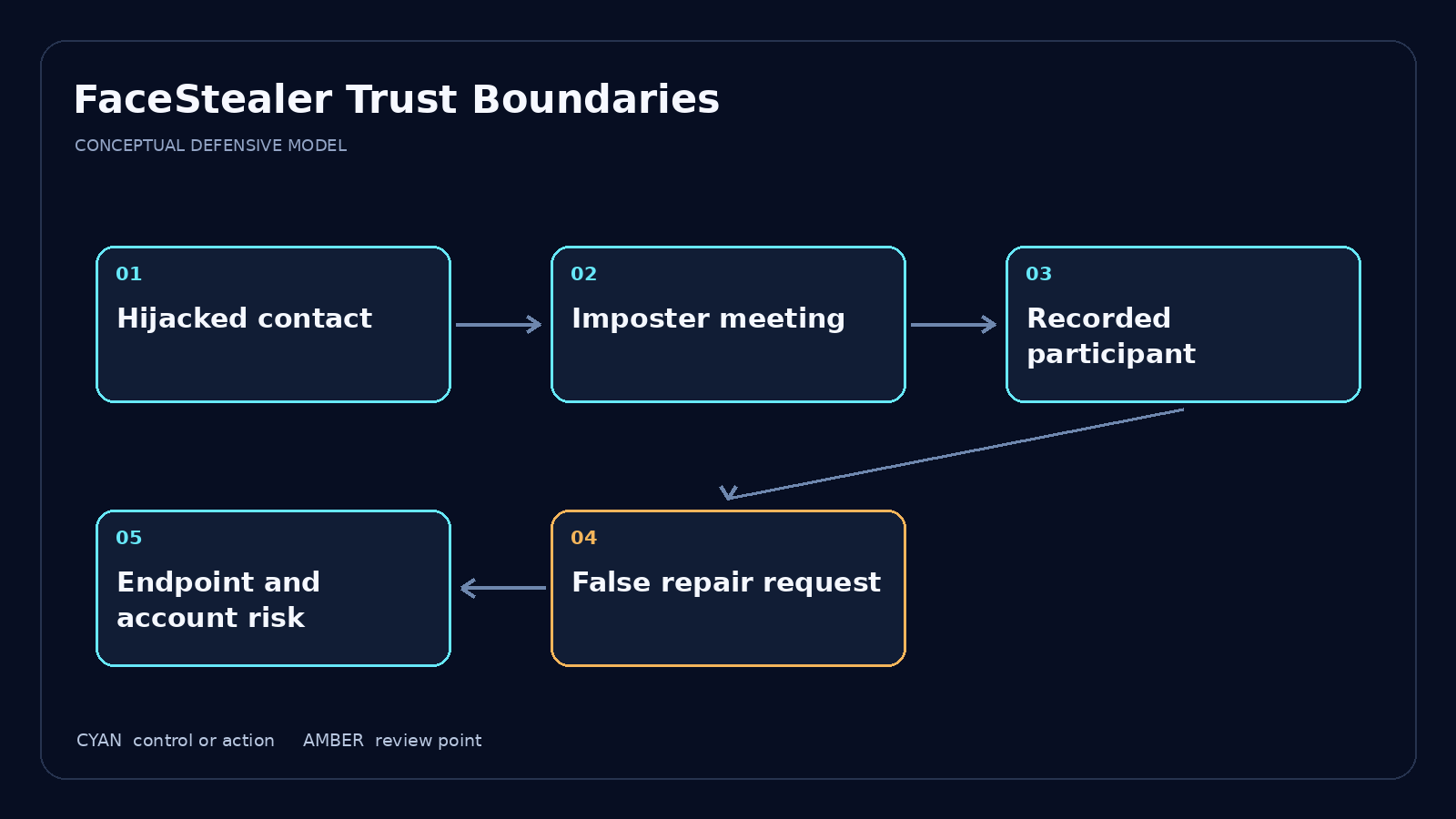
FaceStealer turns a familiar contact and a convincing video meeting into a route toward device and account compromise. The FBI’s November 2026 warning describes North Korean actors using hijacked communication accounts, imposter conferencing sites and recorded webcam video. A recognizable face is part of the lure; it is not proof that a troubleshooting instruction is safe.
The warning matters to software teams as well as cryptocurrency businesses. The FBI identifies targeting of open-source developers and maintainers whose accounts can affect software distribution. Recovery therefore has to examine more than a user’s password. It may involve the device, active sessions, recovery channels, repository permissions, publishing credentials and artifacts produced during the relevant interval.
Primary sources were checked November 14, 2026. The response methods and examples below are proposed defensive workflows. They are not findings from a customer investigation, a claim that a particular package was compromised or evidence of a newly disclosed vulnerability in a conferencing product.
What the November warning establishes
について Justice Department announcement reports disruption of infrastructure associated with FaceStealer, more than $400 million in cryptocurrency theft over 18 months and seizure of more than 900 victim webcam videos. These are reported campaign aggregates. They do not identify a new daily loss total or establish how many software packages were compromised.
について November 12 FBI FLASH describes a sequence in which a compromised account invites a contact to an imposter meeting, recorded video builds confidence and a supposed technical repair leads the target to install malware. The key user decision is accepting the repair request. The warning does not establish a universal zero-click compromise from viewing any meeting page.
That distinction improves triage. Someone who received an invitation, someone who visited a page and someone who executed a purported fix have different exposure histories. They may all need support, but the investigation should record what actually happened rather than assign every person the same incident conclusion.
Continue local recovery after the public disruption. Removing campaign infrastructure can interrupt one part of the operation while previously copied credentials, active sessions or device changes remain relevant. The incident lead should therefore use the user’s actual activity and available records to define closure. The public action supplies threat context; the local evidence determines what this organization can safely restore.
For a developer, the important downstream question is what authority the affected identity could exercise. Repository write access, package publishing, build administration and cloud deployment are different capabilities. Inventory them individually. A general statement that “the developer account is secure again” can conceal an unreviewed publishing token.
Use the campaign name carefully in reports. Similar meeting-themed social engineering can occur without enough evidence to attribute a local incident to FaceStealer. State the observed behavior and the basis for any campaign association. A recognizable pretext is an investigative lead, not a complete attribution method.
Distinguish a meeting lure from a software vulnerability
A fake site can imitate a familiar product without exploiting a defect in that product. The FBI’s sequence centers on social engineering and user-directed execution. An incident report should identify the actual boundary crossed rather than imply that every genuine Zoom, Teams or browser installation is vulnerable to an unspecified zero-day.
That distinction changes remediation. Updating legitimate applications is useful maintenance, but it does not reverse an account takeover or a malicious program the user was persuaded to run. Likewise, blocking one imitation domain does not repair a device that already executed a payload.
Earlier primary research provides context without making every case identical. Microsoft’s Sapphire Sleet analysis, including its June update, describes macOS activity retaining a user-driven execution model while changing lures and components. Use that as a reason to investigate behavior rather than depend entirely on a static visual clue.
Arctic Wolf’s November 12 research describes expansion into other familiar professional workflows. This supports a broader defensive question: can the organization prevent an untrusted interaction from authorizing device changes, even when the story around the request changes?
Do not transfer every indicator, platform detail or component name from an earlier report into a new local incident. Use the relevant source as a lead and verify applicability against the evidence. A macOS analysis does not establish the behavior of an unrelated Windows device, and a similar domain does not prove the same malware ran.
The practical objective is to identify the local execution and access path. Which action changed the device? Which identity was then used? Which systems could that identity reach? Those questions produce a response plan that remains useful even when attribution is incomplete.
The trust transition behind the meeting
The first trust cue is often the communication account. A message can arrive from a genuine account that the recipient already recognizes. Authentication to that account establishes that someone controls it at that moment; it does not prove that the intended person is sending the message or that the device remains trustworthy.
The second cue is context. A proposal can refer to earlier conversations, a collaboration or a planned meeting. Context can make a request plausible, but it still does not authorize a new software installation or command. Separate the expected business conversation from the technical action being requested.
The third cue is the meeting experience. A familiar image, waiting room or group of apparent participants can create a sense of continuity. In the FBI-described scheme, recorded video supports that impression. The trust decision should instead turn on an independently established meeting route and a supported application workflow.
The decisive boundary is the repair instruction. A page or participant asks the user to take an action that changes the device. That action needs a trustworthy source and a legitimate operational reason. A meeting’s appearance cannot grant permission to run software, change a security setting or disclose a credential.
A useful organizational rule is to move technical repair out of the conversation. Staff should have a known support channel and an approved update path they can reach independently. This gives them an action they can take under pressure instead of leaving them to decide whether a convincing participant seems trustworthy.
The rule should apply to senior staff and technical experts as well as new employees. Expertise in one field does not remove the social pressure of a scheduled meeting or an important contact. A process that depends on individuals noticing every visual clue is weaker than one that makes the risky action unnecessary.
Exposure triage before an incident conclusion
Start with a short account of the user’s actions in their own words. Ask about the invitation, the meeting route, downloads, permissions, copied commands, credentials entered and any subsequent account changes. Preserve the original sequence without asking the person to revisit the suspicious site.
Separate direct observation from memory. A browser download record can corroborate a file transfer; it cannot establish execution by itself. A user may remember an instruction but be unsure whether it completed. Record the uncertainty and identify the evidence needed to resolve it.
Use an exposure matrix to determine the next workstream:
| Reported action | Initial question | Appropriate direction |
|---|---|---|
| Invitation received only | Was the sender independently confirmed? | Preserve the lead and verify through a trusted route |
| Meeting page visited | What permissions or downloads occurred? | Assess browser and account exposure |
| File downloaded | Was it opened or executed? | Preserve evidence and review device activity |
| Repair command or installer executed | What ran and with which authority? | Begin endpoint and identity response |
| Account control changed | Which sessions and recovery paths remain? | Recover through supported platform processes |
| Developer access involved | What could the identity publish or modify? | Review repository and release trust |
The matrix is a proposed triage aid, not a diagnostic guarantee. A browser visit can still warrant a deeper investigation if other evidence indicates compromise. Conversely, a suspicious invitation alone does not establish malware execution. Let evidence change the assessment in either direction.
Record the device and account context precisely. A personal laptop used for work can hold corporate sessions or development credentials. A work laptop can also contain personal communication accounts. The ownership label alone does not define the exposed authority; the actual identities and stored access do.
Create one timeline with linked workstreams rather than unrelated tickets that lose the sequence. The endpoint reviewer, identity administrator and repository owner should be able to reconcile their observations by time and evidence reference. They do not all need unrestricted access to every private message or file.
Provide support as soon as the person reports uncertainty. They may not yet know which boundary was crossed, and waiting for them to establish compromise can lose useful evidence or expose more contacts. A calm intake lets the responder capture the sequence accurately and interrupt further interaction. Treat early reporting as operationally valuable, including when the eventual investigation finds that the person stopped before execution.
Separate browser permissions, downloads and execution
A suspicious meeting can involve several technical boundaries before any operating-system program runs. The browser may load a page, request camera access, initiate a download or display instructions. Those events are related in a story, but they are different observations. Triage should preserve that distinction because each points to different evidence and recovery questions.
Camera access can expose an image or recording without establishing that the browser executed a downloaded program. A downloaded file can remain unopened. A copied instruction can be present in a clipboard without having run. Conversely, a user may have executed an instruction and then closed the window before noticing an obvious effect. The responder should investigate the actual sequence rather than use one event as a proxy for all the others.
Ask neutral questions that do not lead the person toward a preferred answer. “What did the page ask you to do next?” can be more informative than “You did not run anything, correct?” Record the person’s confidence and the approximate time. Corroborate where the environment provides relevant records, while recognizing that memory and telemetry can each be incomplete.
A browser warning, if observed, belongs in the timeline. It can help establish which decision the user faced, but its absence from the person’s memory is not proof that no warning appeared. Do not ask the user to reopen the page to recreate the experience on a working device. Preserve available artifacts and use an approved analysis environment if further examination is necessary.
Treat permissions as scoped evidence. A browser’s camera permission applies to a particular origin under its permission model; it is not a general authorization to install software or access repository credentials. Review the actual origin and permission state through supported tools. Do not collapse all browser capabilities into a single “allowed the meeting” event.
The same reasoning applies to remote assistance. A user may have approved a separate access prompt during troubleshooting, which requires its own assessment. Identify the actual software and grant if evidence supports it. Do not infer remote-control software merely because the lure involved a meeting or because another published campaign used one.
This decomposition helps prevent both overreaction and missed exposure. It allows the team to support a person who stopped early while directing endpoint and identity response toward the cases that need it. The final conclusion should name the observed boundaries and the remaining uncertainty rather than rely on an undifferentiated “clicked a link” label.
Reconcile events before asserting a causal chain
A fictional event table can make the investigation’s reasoning visible. The following times and names are invented for illustration; they are not FaceStealer indicators or a product log schema.
| Synthetic observation | Interpretation to test | Evidence still needed |
|---|---|---|
| 09:00, meeting invitation received | A contact account supplied the lure | Independent account-owner confirmation |
| 09:12, meeting page loaded | The user reached an imposter origin | Relevant browser or network evidence |
| 09:18, unfamiliar process began | A repair action may have executed | Parent relationship and executable identity |
| 09:24, developer credential used | Access may have followed device activity | Credential scope and expected workload |
| 09:31, workflow changed | Repository authority may have been exercised | Exact diff, review and identity context |
| 10:05, release published | A downstream artifact may be relevant | Source, build and publication mapping |
The order is consistent with one hypothesis, but timing alone does not prove it. An unfamiliar process can be legitimate software. A credential use can belong to scheduled automation. A workflow change can be an approved maintenance action. The investigator should seek the evidence that distinguishes those explanations.
Use stable identifiers when connecting records. A displayed username or commit author string can be ambiguous. The platform’s own event and credential references can support a more reliable relationship, subject to their documented meaning. Preserve the original identifiers in the protected evidence store and use redacted references in broad summaries.
Check whether the timestamps describe event occurrence, ingestion or display. A delayed log shipment can make an event appear later than the action it records. A release page can show a publication time while a build system records a separate completion time. The timeline should identify those meanings instead of placing every timestamp on one line without explanation.
Record contrary evidence. If an approved change ticket and independent reviewer explain the workflow modification, that matters even when the modification occurred during the incident interval. A defensible investigation tests the initial hypothesis rather than assembling only the facts that support it.
Where retention is missing, identify the specific conclusion affected. Missing process history may limit an execution assessment while account events still establish unauthorized access. Missing release provenance may leave artifact integrity unresolved even after the device is recovered. An evidence gap should narrow a claim, not erase everything the team does know.
The resulting ledger can support a precise final statement: which transitions are established, which remain plausible and which were disproved. That statement is more useful to maintainers and downstream users than a confident narrative whose intermediate steps cannot be independently checked.
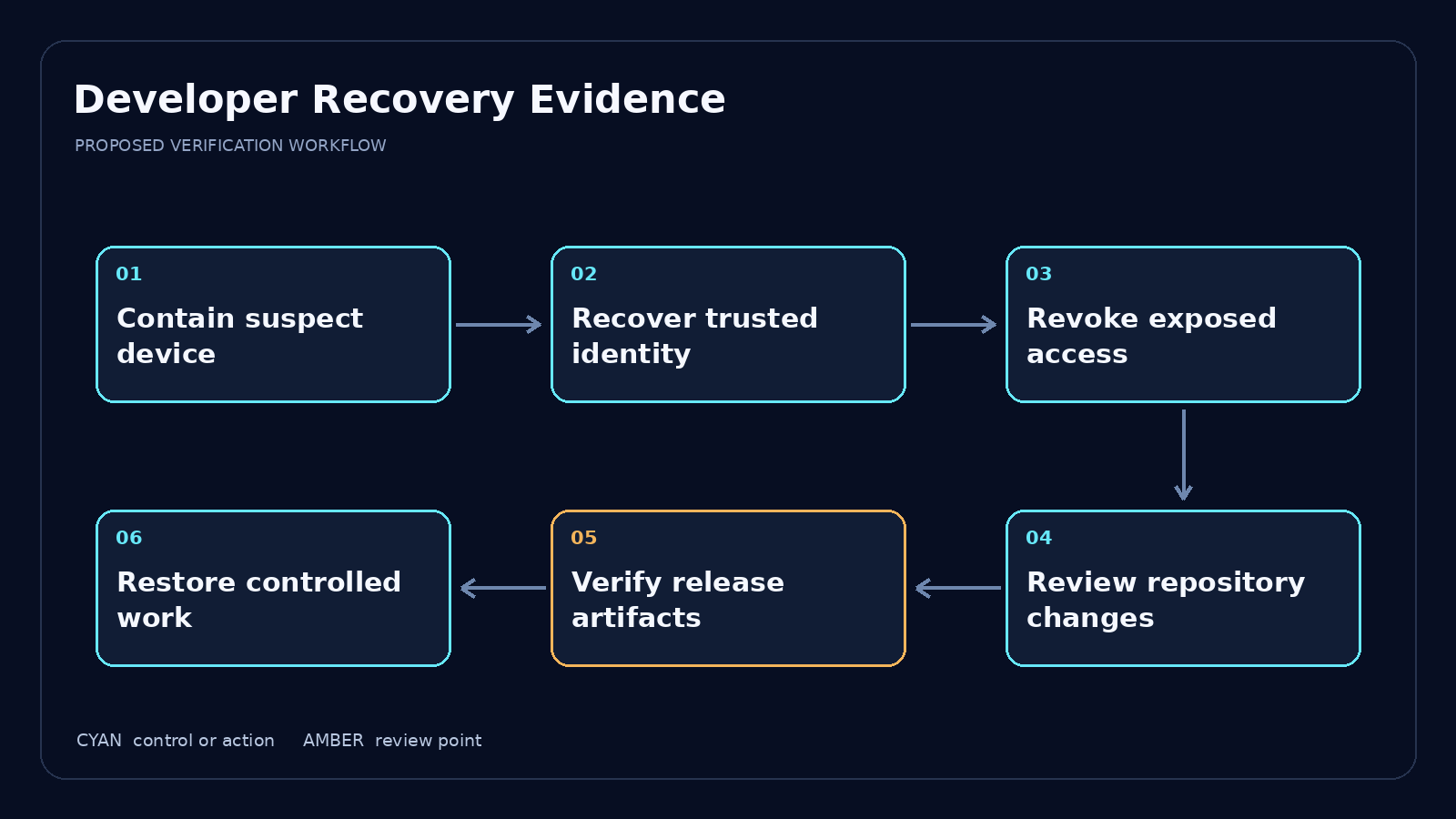
Contain a suspect device without destroying the investigation
When execution is suspected, follow the organization’s incident procedure for isolating the device and preserving relevant evidence. Coordinate with the endpoint owner rather than issuing improvised destructive cleanup steps. The appropriate action depends on the device’s role, ongoing activity and available response tooling.
Avoid entering new credentials on a device that may remain under attacker control. Use a known trusted device and supported recovery channels for account work. A password changed from a compromised environment can become another exposed secret, while the person believes the problem has been resolved.
Preserve the minimum evidence needed to establish what ran and what access followed. Depending on the environment, that can include relevant process history, download metadata, security alerts, account events and files identified by the responder. Do not assume that every organization has the same telemetry or that a missing record proves the action never occurred.
Document containment time separately from correction time. Disconnecting a device can interrupt communication, but it does not establish removal of malware or revocation of external sessions. Keep those outcomes distinct so that the identity team does not assume the endpoint action completed its work.
Plan how the affected person will continue essential work. A safe replacement environment can reduce pressure to reconnect a suspect device prematurely. Provide the minimum access required, verify the user’s identity through an independent route and avoid copying unknown executables or configuration blindly into the replacement.
Evidence preservation should not become uncontrolled copying of private content. A full chat history, webcam recording or personal wallet material can be highly sensitive. The incident lead should define why each item is needed, where it is stored and who may access it. Public reporting should use redacted summaries.
A clean rebuild may be part of the owner’s recovery decision, but it should follow evidence and operational planning. Rebuilding a device does not automatically revoke credentials already copied from it. Treat endpoint recovery and identity recovery as coordinated workstreams with their own acceptance checks.
Recover the communication account and its recovery channels
The account used to contact colleagues deserves prompt attention because it can extend the scheme to more people. Use the platform’s supported recovery process from a trusted environment. Verify the account’s recovery email, phone and authentication methods rather than changing only the primary password.
Review active sessions and connected devices through the supported interface. Determine which sessions are expected and which need revocation under the account owner’s incident process. A password reset can affect sessions differently across services, so establish the actual platform behavior instead of assuming every existing session disappeared.
Review authorized applications and integrations. A persistent authorization can provide access through a path that looks different from an interactive login. Record what was present, what the owner approved and what was removed. Keep evidence of suspicious changes where the platform makes it available.
Enable or restore suitable multi-factor protection and recovery methods. Treat the recovery channel as part of the account’s security boundary. An account with strong primary authentication can still be difficult to trust if an attacker controls the email address or phone used to recover it.
について FBI FLASH recommendations include independent confirmation of meetings, avoiding terminal-based repair instructions and securing affected accounts and sessions. The following recovery process operationalizes those principles; it is not a claim that one generic reset sequence works identically on every communication platform.
Record the final account state and the unresolved questions. Can the owner sign in from a trusted device? Are expected recovery methods intact? Have relevant sessions and authorizations been reviewed? Is there evidence that contacts were messaged? A successful login is only one of those results.
Keep account recovery communications on an independently verified route. A message sent through the account under investigation cannot establish that its recipient is the rightful owner. This matters especially when an attacker may be impersonating a colleague who is also trying to recover access.
Keep wallet secrets out of the recovery workspace
A cryptocurrency-related incident can involve recovery phrases or private keys that grant access independently of an ordinary account password. The FBI FLASH warns that exposed recovery material can remain relevant long after the initial intrusion. Treat that material as a separate security concern in the response inventory.
Do not ask a victim to paste recovery phrases into a ticket, model prompt, shared document or unfamiliar verification page. An investigator generally needs to establish whether sensitive material may have been accessible, not collect the secret into another broadly accessible system. Use approved procedures and qualified responders for any necessary handling.
Keep the incident evidence and asset-management decisions distinct. This article does not recommend an investment action or perform a cryptocurrency transfer. The security task is to identify the exposed authority, preserve relevant evidence and coordinate through independently verified support and response channels.
A suspicious recovery website can reproduce the same trust problem as the original meeting. A familiar logo, urgent message or helpful participant does not establish that the destination is authorized to receive a secret. The affected person should reach trusted services independently and avoid following new instructions through a compromised communication account.
Record decisions by reference rather than by secret value. The response ledger can identify the responsible owner, the type of exposed material and the completion status of the approved recovery process. It should never become a convenient central collection of live wallet credentials.
This handling rule also applies to software signing keys and package-publishing credentials. The value that grants authority should stay in the appropriate protected system, while the response package records what was assessed and which authorized action closed the relevant exposure.
Trace developer authority beyond the primary login
A developer’s authority can exist in many forms: interactive sessions, SSH keys, personal access tokens, application authorizations, deploy keys and package-publishing credentials. Inventory what the affected device or account could access, then assign the relevant platform owners. Do not assume that one password controls every capability.
GitHub’s credential-revocation documentation distinguishes revoking SSO authorizations from deleting credentials, with options dependent on account type. Follow the applicable supported process and understand its consequences. A broad credential action can disrupt automation, so coordinate recovery and replacement rather than leaving essential services to fail unpredictably.
For each credential, record its owner, scope, storage location, last known use and recovery action. Use an evidence reference instead of placing the secret itself in the register. The register should help answer which access paths remain, not create a new repository of live credentials.
Review organization membership and repository permissions independently of credential replacement. A new token issued to the same overprivileged account can preserve an unnecessary exposure. Restore only the authority needed for the person’s role, and review unexplained privilege changes during the incident interval.
Separate personal credentials from automation identities. A build system should not become an unrecognized dependency on a maintainer’s personal token. Where such dependencies exist, identify them openly and plan a supported transition with the automation owner. Do not rotate a credential without understanding which release process uses it.
Check recovery methods for the developer platform as well. An attacker who changes an authentication or recovery setting can regain access after a superficial reset. The effective account state should be reviewed from the platform’s supported security view and corroborated with available events.
Keep credential recovery tied to artifact review. A token can be revoked now while a malicious or unexplained change made earlier remains in a repository or release. Closing the access path is necessary, but it does not establish the integrity of everything that path could have produced.
Repository changes and their authority
Begin with the repositories and branches the affected identity could modify during the exposure interval. Establish the expected baseline and the people authorized to approve changes. A list of commits is useful evidence, but the investigation needs to explain whether each material change followed the intended process.
Review workflow and build changes alongside application code. A small modification to release automation, dependency resolution or artifact upload can affect the output without appearing in the application’s main source path. Prioritize changes that alter authority, inputs or publication behavior.
Inspect repository settings and protection changes where relevant records are available. A branch-protection change can matter even if a later commit looks ordinary. Record the state, timing and responsible identity before deciding whether it was legitimate maintenance, a response action or unexplained activity.
GitHub’s security-event reference documents categories for personal-account activity, including credential and application-related events. Use the actual account and organization records available to the incident team. Do not invent a universal event schema or imply that one log contains every repository and package action.
For each unexplained change, inspect the exact diff, expected review, platform identity and relationship to a build or release. Correlate those records before assigning an attribution. A commit’s displayed author and time can start the inquiry, while the surrounding platform evidence helps establish who exercised authority and what output, if any, reached users. Preserve contrary evidence as carefully as supporting observations.
Use a trusted review environment. Do not execute an unknown build script simply to inspect a repository suspected of compromise. Start with static examination and the organization’s supported artifact-analysis process. Any execution should occur under a separately approved containment and analysis plan.
Preserve legitimate work while restoring trust. Maintainers may have made valid changes during the incident interval. A blanket rollback can erase those changes or obscure the sequence. Identify the minimum corrective action supported by the evidence and document the authority for taking it.
Verify package and release integrity independently
Repository recovery and release recovery are related but separate. A clean current branch does not establish the contents of a package published earlier. Identify the release artifacts the affected identity could create, modify or distribute, and map each to its source, build and publication records.
Record the relevant artifact identifiers and hashes through the organization’s normal process. Compare them with a trusted release record, not a filename supplied by the same account under investigation. A matching name or version label can conceal different content. The reviewer needs an identity for the actual bytes.
Examine the build inputs that matter to the artifact. Source commit, dependency lock state, build configuration and publication identity can each affect the result. The appropriate evidence depends on the project. Do not imply that a hash comparison alone proves the build environment or every dependency was trustworthy.
If the project uses signing or provenance, verify the evidence according to the project’s supported policy. A valid signature establishes a relationship to a signing identity under stated assumptions. It does not automatically establish that the signer, build inputs or approval process were uncompromised during the incident.
Use a bounded distribution review. Determine which artifacts were published during the relevant interval and where they were made available. Do not announce a package as malicious solely because its maintainer was targeted. A public claim should reflect artifact evidence and the responsible project’s investigation.
If an artifact requires withdrawal or replacement, coordinate with the project’s release owner and relevant platforms. Those decisions can have substantial downstream consequences. Preserve evidence and communicate the exact affected identifiers through verified channels, with a clear distinction between confirmed and still-investigated scope.
A release should return to normal operation only when the owners can explain both current publication authority and the integrity decision for relevant existing artifacts. Removing an exposed token closes one path; it does not settle the historical artifact question.
Notify contacts without extending the impersonation problem
について FBI advisory recommends notifying contacts and employers when relevant accounts or work information may have been exposed. Prepare that communication through the incident lead and use a route that the recipients can independently verify. Do not rely solely on the account that may have been used to impersonate the victim.
A useful notice states the affected communication channel, the approximate interval and the action recipients should take. It can ask them to avoid recent unexpected meeting links and report whether they followed a technical repair instruction. It should not include an executable attachment or ask recipients to enter credentials into a new “recovery” site.
Keep the notice proportionate to the evidence. “An account was used to send unauthorized messages” is different from “all contacts were compromised.” The first can be supported by account records; the second usually requires much more. Avoid expanding a local finding into an unsupported campaign-wide claim.
Provide a known support contact. Recipients should be able to confirm the notice through an established company site, previously known phone number or another verified organizational route. A new account appearing during a recovery effort needs its own verification.
Do not distribute raw victim video, chat histories or private contact lists as proof. Such material can create additional harm and is rarely necessary to tell recipients what they should do. Use redacted evidence only where it serves a defined investigative purpose and the responsible owner permits it.
Maintain a notification register with the audience, approved text, delivery route and follow-up owner. This article describes the method; it does not send any messages. A register helps the response team answer who was warned and which reports still need triage without exposing everyone’s private communications.
Treat incoming replies as untrusted until verified. An attacker may participate in the same channels or try to exploit confusion about recovery. Staff should know how to route a new report to the incident team without accepting additional repair instructions from an unfamiliar participant.
Correlate behavior instead of relying on one indicator
A detection plan should connect the social interaction, device activity and identity events where evidence is available. The goal is to identify a meaningful sequence: an unexpected meeting, a repair action, unusual execution and subsequent access changes. No single step necessarily proves the entire chain.
Use actual telemetry from the environment. Browser and endpoint tools differ in what they record, how long records remain and whether clocks are synchronized. Begin with a data-source inventory so analysts understand what a missing event means. A query cannot find an event the organization never collected.
Separate prevention evidence from incident evidence. A blocked download can show that one control stopped one attempted action. It does not establish that no other action occurred before or after it. Likewise, a successful endpoint alert can be useful without proving that every exposed session was revoked.
Write hypotheses with disconfirming conditions. For example, an unusual login may be legitimate travel or a known automation path. Ask which supporting records would distinguish those explanations from unauthorized use. A good investigation remains open to evidence that narrows or changes its first interpretation.
Avoid turning research indicators into permanent identity rules. Domains, file names and infrastructure can change. Primary reports can provide useful starting points, but behavior and authority remain important. The response should not depend on finding the exact string from a published screenshot.
Keep detection logic separate from a public article’s illustrative data. A table using fictional account names or times can explain an investigation method, but it must not be presented as a tested product query or a universal log schema. Validate operational detections in the environment where they will run.
Review the outcome of a detection with the affected platform owner. An analyst may see an application authorization but need an administrator to determine its actual scope. Cross-team interpretation can prevent both false reassurance and unnecessary disruption.
Model recovery as removal of access paths
The following Python example is a harmless in-memory graph. It contains no real accounts, tokens, files or network requests. It illustrates a common recovery mistake: removing a password-based path while leaving sessions and publication credentials usable.
The fictional graph starts at a suspect device and reaches developer resources through three different nodes. A traversal represents possible access in the toy, not a real authentication protocol. Blocking a node models an independently completed revocation decision. The example makes no claim about which actions a particular platform automatically performs.
graph = {
    "suspect-device": {
        "password-login", "web-session", "publish-token"
    },
    "password-login": {"repository"},
    "web-session": {"repository"},
    "publish-token": {"package-registry"},
    "repository": set(),
    "package-registry": set(),
}

def reachable(start, blocked):
    seen, pending = set(), [start]
    while pending:
        node = pending.pop()
        if node in blocked or node in seen:
            continue
        seen.add(node)
        pending.extend(graph.get(node, set()))
    return seen

password_reset_only = {"password-login"}
remaining = reachable("suspect-device", password_reset_only)
assert "repository" in remaining
assert "package-registry" in remaining

all_toy_access_revoked = {
    "password-login", "web-session", "publish-token"
}
closed = reachable("suspect-device", all_toy_access_revoked)
assert "repository" not in closed
assert "package-registry" not in closed

print("Toy access-path recovery checks passed.")
The first test intentionally leaves two paths. It does not say that every service behaves this way after a password reset. It says that the response owner must verify the platform’s actual session and credential semantics rather than assuming a reset has the broadest possible effect.
The second test closes the paths represented in this small graph. A real environment may have more nodes: recovery accounts, authorized applications, deploy keys, cloud identities or separate package credentials. The inventory determines which paths need assessment. The toy is complete only within its deliberately declared scope.
Existing artifacts are outside the graph. Even after access is revoked, a repository change or published package may still require review. This is why recovery needs separate evidence for current access and historical integrity. One successful revocation test cannot settle both.
Use the exercise in training by asking participants to add a fictional recovery channel or automation credential, then identify the new closure condition. Keep the exercise entirely synthetic. The learning objective is to recognize independent authority paths, not to collect or manipulate real credentials.
Restore controlled work from a trustworthy environment
The recovery plan should identify the environment from which the user will resume work. A clean device, restored identity and reviewed repository are different prerequisites. The responsible owners should state which of them are complete and which are still pending.
Test a small normal workflow with the restored identity. For a developer, that might be reading an approved repository and proposing a harmless change through the normal review process. For a release operator, use the project’s supported staging publication path rather than an unnecessary production release.
Pair the normal workflow with a denied path relevant to the incident. A retired credential should no longer access the protected resource. A removed authorization should no longer perform the former action. Use harmless verification methods and coordinate with platform owners so the test does not create a new incident.
Record the actual observation, not merely the administrative request. A ticket marked “token rotated” may not establish that the old token was revoked or that every deployment stopped using it. Reconcile the change with effective access and the automation dependencies identified earlier.
Keep the restored environment free of unexplained material from the suspect one. Source, configuration and user data may need migration, but executable components and credential stores deserve careful handling. Follow the organization’s supported rebuild and restoration process rather than copying a home directory wholesale.
The user needs a clear statement of what work may resume. “Your laptop is back” is ambiguous if publishing access remains under review. Provide the permitted activities, temporary restrictions and the person who can approve the next expansion. This reduces pressure to improvise around an unresolved control.
Make safe meeting behavior easy to follow
The strongest meeting policy gives staff a practical alternative at the moment of pressure. Use known official applications and independently obtained meeting details. If a meeting appears to require an unusual repair, move the issue to the organization’s established support channel rather than following instructions from the meeting page.
Training should focus on the action boundary. Staff do not need to become experts in spotting every fabricated face or domain trick. They need to recognize that a conversation does not authorize terminal commands, software installation, security-setting changes or credential disclosure.
Provide an approved update path that is easy to find. If genuine applications frequently require confusing manual repair, users may become accustomed to accepting similar instructions. Good maintenance and support usability reduce the opportunity for a malicious pretext to blend into normal work.
Use independent verification for consequential requests. A second message through the same potentially hijacked account is not independent. Choose a previously established route that does not depend on the suspect session. The method should be agreed in advance for teams that handle sensitive systems or releases.
Make reporting friction low. A user who stopped before execution should be able to report the attempt without a long incident form. A user who is unsure what happened should receive help rather than blame. The response process should reward early disclosure of uncertainty.
Review camera and browser permissions under the organization’s normal policy. Permissions are relevant evidence and controls, but they should not be marketed as a complete solution to the scheme. A person can be deceived through a familiar contact even when one particular browser permission is restricted.
Include contractors and open-source collaborators in the communication design where relevant. They may not have access to an internal help desk, so establish a safe way to confirm a meeting or report an impersonation. A policy that works only for employees leaves important relationships outside the process.
Run a tabletop without simulating a real intrusion
A tabletop can examine the response chain using fictional messages and account records. Do not send deceptive invitations to uninformed participants or ask anyone to run a repair script. The exercise can be effective without executing malware or collecting a webcam recording.
Begin with a scenario card: a maintainer reports a meeting link and is unsure whether a downloaded file ran. Give participants a small set of synthetic observations with timestamps and deliberate gaps. Ask them to identify the next evidence needed and the owner responsible for obtaining it.
Introduce an account-recovery complication. A fictional session remains active after a password reset, or an automation process depends on a token scheduled for revocation. The team should resolve the dependency through an approved plan rather than skipping revocation or accepting an unexplained outage.
Add an artifact question. A release occurred during the uncertain interval, but the source branch now looks normal. Ask the team to identify the artifact, build and publication evidence needed before making a public integrity statement. The correct answer may be that the evidence is incomplete.
Evaluate communication quality. Can the team prepare a precise notice that helps contacts act without claiming everyone was breached? Can recipients independently verify the notice? Does the message avoid distributing private evidence or introducing a new credential-collection page?
Record the exercise findings as process improvements. Missing owners, unclear log retention and an untested recovery route are concrete outcomes. Do not grade success solely by how quickly the team declares the scenario closed. A careful unresolved conclusion can be the right result.
Repeat the exercise after material changes in release tooling, identity management or communication platforms. The objective is a response process that remains usable as the environment changes, not a one-time training attendance record.
Preserve an evidence package without overcollecting
Use an evidence index that links each conclusion to its supporting observation. Include the original timestamp, source system, collection method and reviewer. If data was normalized or redacted, record the transformation so that another authorized reviewer can understand what changed.
Separate raw evidence from the working summary. The summary should contain the information required for decisions, while sensitive records remain in an approved store. This makes it easier to share operational conclusions with people who do not need access to private messages, recordings or device contents.
Define the investigation interval honestly. The first suspicious meeting may not be the first compromise, and the final password reset may not be the end of access. Use available evidence to establish bounds and identify uncertainty. A precise-looking timestamp without support can be more misleading than an explicitly approximate interval.
Retain the distinction between platform action and effective outcome. A revocation request, a completed revocation and a verified denial are related records with different meanings. A high-quality package lets the reviewer follow that sequence without assuming a step occurred.
For repository and artifact work, bind evidence to exact identifiers. A branch name can move, a release tag can be changed and a package label may not identify immutable bytes. Use the project’s supported evidence and provenance methods to make the integrity decision reviewable.
Minimize exposure in vendor support and cross-organization coordination. Share a sanitized account or event reference where possible, then use an approved secure route if detailed material is necessary. A recovery effort should not create a second uncontrolled distribution of the victim’s private information.
State retention and access decisions under the organization’s established process. This article does not prescribe a universal legal retention period. The useful operational requirement is that necessary evidence remains available to the people responsible for the response while unnecessary sensitive copies are avoided.
Work through a fictional maintainer recovery
Consider a fictional maintainer, Morgan, who receives a meeting invitation from an account belonging to a known collaborator. During the meeting, a participant asks Morgan to run a repair command. Morgan reports having executed it but is unsure whether the command completed. This is an exercise scenario, not an account of a real victim.
The incident lead records the sequence and coordinates endpoint containment. Morgan uses a trusted replacement device for account recovery. The team reviews communication sessions and recovery methods, then identifies which developer and publishing credentials may have been accessible on the suspect device.
The repository owner finds a workflow change during the uncertain interval. The change has an apparently ordinary commit message, but no expected review. The team preserves it and examines the exact diff and its relationship to the build. It does not declare the package malicious solely from the timing.
A release was also published. The release owner maps the artifact to source and build records, compares the relevant evidence and determines what remains unexplained. Current account recovery proceeds in parallel. The release question remains open until the artifact evidence supports a conclusion.
The communications owner prepares a warning for potentially contacted collaborators using an independently verified organizational route. The notice identifies the relevant channel and interval, asks recipients to report any repair action and avoids distributing the original suspicious link as a clickable instruction.
At restoration, the team verifies a harmless normal developer workflow and the denial of retired credentials. It records which activities Morgan can resume and which publication permissions remain restricted pending review. This gives the maintainer a practical path back to work without hiding the unresolved artifact task.
The example demonstrates the value of separate closure states. Endpoint recovery, identity control, repository review, artifact integrity and contact notification can progress at different speeds. A single “incident resolved” label would conceal those differences and make the handoff harder.
Know what a testing product can and cannot establish
An authorized application assessment can help verify controls within its actual target and method support. It cannot, by itself, prove that a person’s device is free of malware, recover a hijacked messaging account or establish the integrity of every release produced with a stolen credential.
Before using any product in the response, identify the question it will answer and the evidence it can produce. A scan result, browser observation and endpoint investigation are different evidence types. Use each where it is appropriate and retain its limits in the report.
For teams evaluating Penligent or another assessment workflow, define an owned application fixture and a reproducible security property. Review the result as application evidence. Do not market an application test as a complete FaceStealer cleanup or a guarantee against social engineering.
The response lead should coordinate the disciplines rather than force every task through one tool. Identity administrators, endpoint responders, maintainers and release owners each control part of the recovery. Their evidence becomes useful when it is connected by a consistent timeline and explicit ownership.
Frequently asked questions
What is FaceStealer?
- The FBI uses the name for a North Korean social engineering scheme involving imposter meetings, compromised communication accounts and victim video.
- The practical risk is the transition from a trusted-looking interaction into unauthorized device or account access.
Does a familiar face prove that a meeting is genuine?
- No. A recognizable image and a genuine account can both be misused.
- Verify consequential requests through an independent route and use the organization’s supported meeting and update process.
Is visiting a suspicious meeting page proof of compromise?
- It is an exposure event to assess, not a complete incident conclusion.
- Record permissions, downloads, execution and account changes, then use available evidence to determine the appropriate response.
Is changing a password enough?
- Verify the platform’s actual session, credential, authorization and recovery behavior.
- Developer and publishing access may exist through independent paths that require their own review.
Why are open-source maintainers relevant?
- The FBI identifies them as targets whose account access can affect software distribution.
- Review repository changes and release artifacts separately from current account control.
Can a security alert prove that recovery is complete?
- An alert can support an observation within its collection and detection scope.
- Recovery also needs evidence for effective revocation, the restored environment and any affected repository or artifact decisions.
What should a team do before resuming releases?
- Establish trusted publication authority and resolve the relevant artifact-integrity questions with the release owner.
- Record any remaining restrictions and verification tasks instead of relying on a single account-login success.
The response is complete only to the extent the evidence supports it. Restore the person through a trustworthy environment, close the relevant access paths and make a separate integrity decision about the software those paths could affect. That breaks the chain the meeting was designed to exploit.
The following official Penligent video presents the general product workflow. It is separate from the source research and does not demonstrate or certify the specific findings discussed above.
 Japanese
 English
 German
 French
 Spanish
 Portuguese
 Korean
 Hindi
 Arabic
 Turkish
 Hebrew