CVE-2026-21510 is categorized as a protection mechanism failure em Windows Shell that allows an unauthorized attacker to bypass a security feature over a network, with a CVSS v3.1 base score of 8.8 and vector AV:N/AC:L/PR:N/UI:R/S:U/C:H/I:H/A:H. (NVD)
That vector matters. This is not “remote code execution with zero clicks.” It’s worse in a more operational way: it’s a “one click, less friction” problem. The attacker still needs user interaction, but if the OS fails to apply the normal warning/guardrail at the exact moment the user decides whether to proceed, social engineering conversion rates jump.
Multiple Patch Tuesday analyses state the issue was ativamente explorados na natureza e publicly disclosed. (Rapid7)
CISA also referenced CVE-2026-21510 in its exploited-vulnerability communications and KEV ecosystem. (CISA)
If you lead security operations, the practical takeaway is blunt:
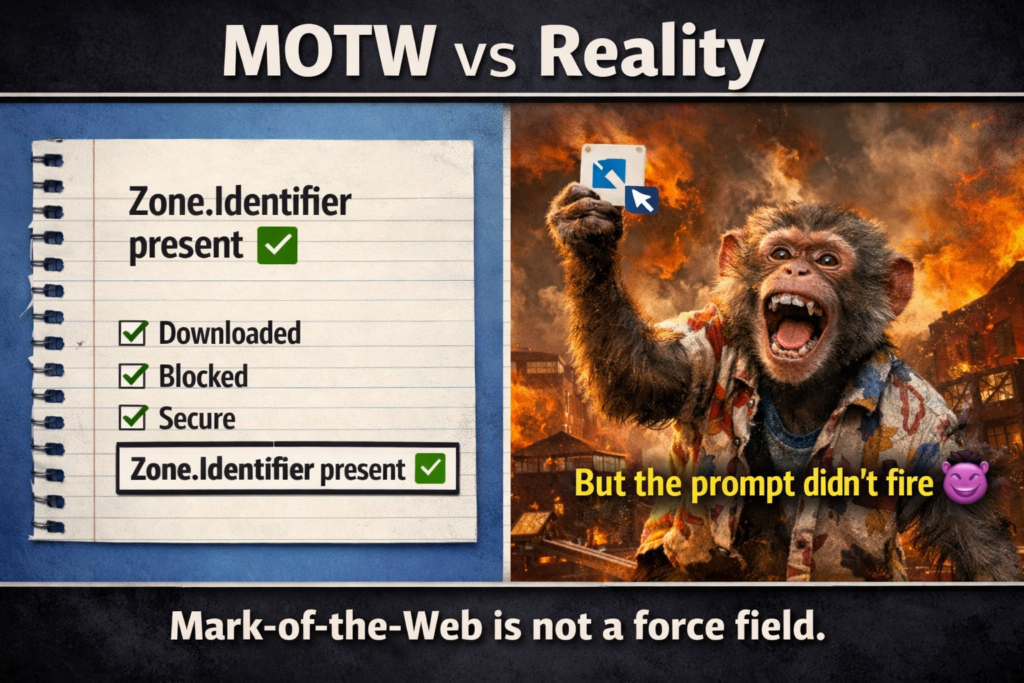
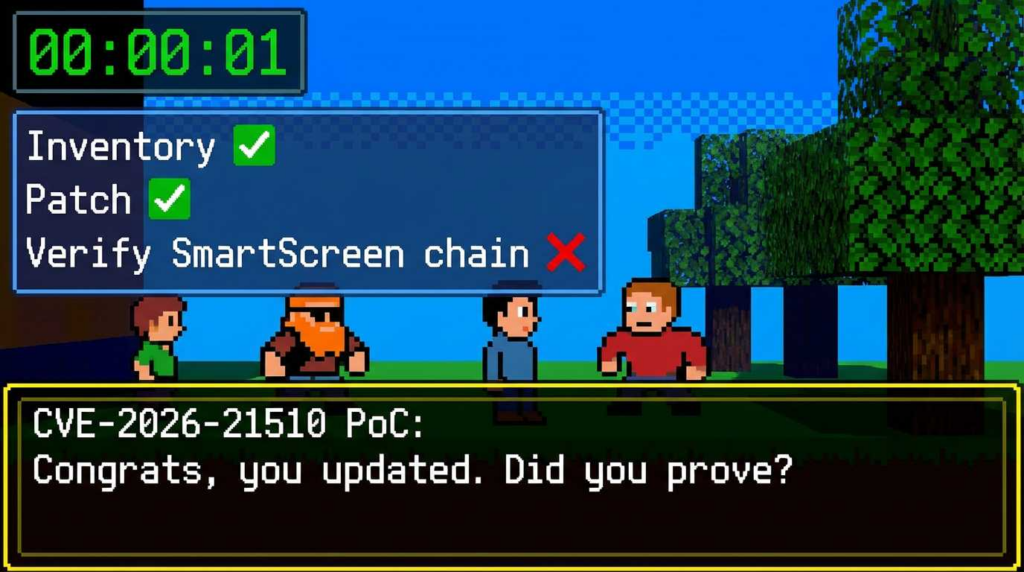
If you treat this as “just patch,” you will miss the part that actually saves you: proving that your SmartScreen / Mark-of-the-Web (MOTW) trust chain still works end-to-end in your environment.
Official description (NVD/CVE): “Protection mechanism failure in Windows Shell allows an unauthorized attacker to bypass a security feature over a network.” (NVD)
Severity: CVSS 8.8 (High), user interaction required (UI:R). (NVD)
Patch cycle context: Public analyses frame it as one of the February 2026 zero-days addressed, alongside other actively exploited items. (Tenable®)
Exploitation status: Multiple security vendors report Microsoft confirmed active exploitation and public disclosure. (CrowdStrike)
Adjacent exploited bypasses/EoP in the same cycle: CVE-2026-21513 (MSHTML bypass), CVE-2026-21514 (Word bypass), CVE-2026-21519 (DWM elevation of privilege) are repeatedly highlighted in the same Patch Tuesday reporting. (Tenable®)
Why “security feature bypass” is an attacker’s favorite category
Security engineers often underestimate bypass bugs because they don’t always look like a classic memory corruption headline. But attackers don’t care about category names. They care about probability.
If friction is reduced, post-click payload gets a chance
A bypass vulnerability is a funnel widener. It increases the odds that step (3) fails to stop step (4).
This is exactly why February 2026 reporting frames multiple “security feature bypass” items together: they occupy the same attacker niche—make the user’s single mistake more likely to become your incident. (Tenable®)
What attackers can realistically do
Public write-ups consistently describe a scenario where an attacker convinces a user to open remote-delivered content through common channels. In at least one institutional advisory, the example explicitly includes a shortcut (.lnk) lure. (York University)
What you should assume as a defender (and instrument for):
The lure is likely to be “low effort, high believability” (shared file link, “invoice,” “team doc,” “security update,” “meeting notes,” etc.).
The first-stage action is not necessarily a macro or a binary drop. It can be a file that triggers Shell behaviors and trust checks.
The attacker’s real objective is to get qualquer execution foothold, then move to persistence, credential access, and lateral movement with tools that are already common in your telemetry.
You do não need to know the internal bypass trick to defend. You need to know where the trust boundary is supposed to be—and how to detect when it’s missing.
How to prioritize CVE-2026-21510 in the real world
The prioritization rule that survives audits
When CISA highlights exploited vulnerabilities and the KEV ecosystem references a CVE, it becomes much easier to justify emergency change windows. You’re not just reacting; you’re aligning to a federal exploited-vuln framework. (CISA)
The sequencing logic that reduces total risk
Don’t treat CVE-2026-21510 as a standalone. February 2026 coverage repeatedly groups it with:
CVE-2026-21514 (Microsoft Word security feature bypass) (Tenable®)
CVE-2026-21519 (DWM elevation of privilege) (Tenable®)
That grouping is operationally meaningful: a realistic chain is “initial access conversion” (bypass) → “capability upgrade” (EoP). You should patch in a way that reduces both.
The playbook: prove you’re protected, not just “patched”
The three-layer verification model
Most orgs stop at “patch deployed.” For bypass-class issues, that’s incomplete.
You want three proofs:
Coverage proof (asset layer): Which endpoints are in scope? (OS families, build ranges, VDI templates, golden images).
Update proof (patch layer): Patch is present where it should be.
Guardrail proof (control layer): MOTW + SmartScreen + Shell trust checks still trigger as expected for external-origin content.
That third layer is where bypass incidents still happen even after “we updated everything” (because “everything” rarely includes offline images, contractors’ laptops, dev VMs, lab machines, and VDI snapshots).
Below is a practical set of checks you can run at scale with your endpoint management tooling (Intune, SCCM, RMM, EDR live response, etc.). These do not attempt exploitation—they produce evidências.
The point isn’t “MOTW exists.” The point is: are externally sourced files consistently tagged e handled with the expected friction?
# Sample common drop locations for Zone.Identifier ADS
$paths = @("$env:USERPROFILE\\Downloads", "$env:TEMP")
foreach ($p in $paths) {
  if (Test-Path $p) {
    Get-ChildItem $p -Recurse -File -ErrorAction SilentlyContinue |
      ForEach-Object {
        $streams = Get-Item -LiteralPath $_.FullName -Stream * -ErrorAction SilentlyContinue
        if ($streams.Stream -contains "Zone.Identifier") {
          [PSCustomObject]@{ File = $_.FullName; HasMOTW = $true }
        }
      }
  }
}
4) Controlled validation
You should create a safe internal test artifact and workflow that simulates external origin without using real malware. What you’re proving is:
External origin → MOTW applied
External origin → SmartScreen / Shell warning triggers as expected
User attempts to proceed → your endpoint controls respond per baseline
You can do this by signing and hosting benign binaries/scripts internally, applying MOTW deliberately in a test VM, and confirming the expected user-facing friction and EDR logging. (Don’t do this in production end-user sessions; use a sandboxed test group.)
SOC hunting: detect the “missing friction” moment
A detection-oriented note from Stamus Networks describes using network hunting to determine if systems have been attacked or are vulnerable with respect to CVE-2026-21510 (and a related CVE). (stamus-networks.com)
Whether you use an NDR product or not, the concept is portable: bypass incidents show up as post-click behavior without the expected pre-click warnings.
These are intentionally generic and should be adapted to your data sources (Defender, Sysmon, EDR, proxy logs). They are designed to get you to candidate machines/users fast.
Microsoft Sentinel / Defender (KQL-style)
// 1) Explorer spawning suspicious children shortly after file download events (high-level template)
let lookback = 7d;
DeviceProcessEvents
| where Timestamp > ago(lookback)
| where InitiatingProcessFileName =~ "explorer.exe"
| where ProcessCommandLine has_any ("powershell", "wscript", "cscript", "mshta", "rundll32")
| project Timestamp, DeviceName, AccountName, FileName, ProcessCommandLine, InitiatingProcessCommandLine
| order by Timestamp desc
// 2) Correlate downloads directory executions (template)
let lookback = 7d;
DeviceProcessEvents
| where Timestamp > ago(lookback)
| where FolderPath has "\\\\Users\\\\" and FolderPath has_any ("\\\\Downloads\\\\", "\\\\AppData\\\\Local\\\\Temp\\\\")
| project Timestamp, DeviceName, AccountName, FileName, FolderPath, ProcessCommandLine
| order by Timestamp desc
Splunk (process execution)
index=endpoint earliest=-7d
(ParentImage="*\\\\explorer.exe" OR ParentProcessName="explorer.exe")
(Image="*\\\\powershell.exe" OR Image="*\\\\wscript.exe" OR Image="*\\\\cscript.exe" OR Image="*\\\\mshta.exe" OR Image="*\\\\rundll32.exe")
| stats count values(CommandLine) as CommandLine values(User) as User by host, Image, ParentImage
| sort - count
Elastic (EQL-ish pseudocode)
process where parent.name == "explorer.exe"
  and process.name in ("powershell.exe","wscript.exe","cscript.exe","mshta.exe","rundll32.exe")
  and process.args_count > 2
These won’t magically “detect CVE-2026-21510.” They’ll find the kind of post-click execution patterns that bypass bugs are designed to enable.
The February 2026 cluster: related CVEs you should include in your narrative
The public reporting makes it clear this cycle wasn’t “just one bypass.”
Here is a compact table you can drop into an internal briefing deck.
CVE
Component / Type
Why it matters operationally
Public reporting signal
CVE-2026-21510
Windows Shell / Security Feature Bypass
Reduces user-facing friction at the click moment; widens initial-access funnel
Mitigations that matter even before patching finishes
You will not patch every endpoint instantly. While patching rolls out, the goal is to make the bypass less valuable.
1) Reduce exposure to untrusted delivery channels
Tighten email attachment policies for shortcut-like artifacts and nested containers
Enforce URL rewriting / detonation for unknown domains
Add guardrails in chat/collaboration tools where file-sharing is common
2) Make MOTW harder to lose
Some tools and workflows strip Zone.Identifier (e.g., certain archive extractors, file transfer tools). You don’t need to ban everything. You need to identify which workflows break your trust chain and either:
Fix them
Replace them
Monitor them
3) Expand telemetry for “click-to-execution” windows
Short windows matter. If you can’t instrument everything, prioritize the 0–5 minute interval after:
a download completes
a file is opened from Downloads/Temp
explorer spawns a script host
CVE-2026-21510 is a textbook case of why “patching” is not the end of vulnerability management.
Your real job is verification:
Did the patch land everywhere it should?
Did it land on VDI templates and gold images?
Is SmartScreen/MOTW behavior still correct across browsers, proxies, unzip tools, and enterprise file-sharing workflows?
Can you produce evidence for auditors and leadership?
Penligent’s most defensible value here is not “exploit generation.” It’s turning these questions into repeatable, evidence-driven validation runs: asset discovery → control-path verification → reporting that you can hand to a customer, auditor, or internal risk committee.
For broader context on vulnerability management as an evidence lifecycle (not a scanner output), Penligent has published multiple long-form analyses that align with this posture. (penligent.ai)
PERGUNTAS FREQUENTES
“Is this remote code execution?”
Public classification frames it as a security feature bypass (protection mechanism failure), not “unauthenticated RCE with no clicks.” The vector includes UI:R, meaning a user action is required. (NVD)
“If a click is still required, why is this urgent?”
Because friction is what keeps most phishing and drive-by attempts from converting. Multiple vendor analyses treat this as actively exploited and publicly disclosed; CISA’s exploited-vuln posture reinforces urgency. (Tenable®)
“What’s the fastest way to know if we were hit?”
Don’t wait for a signature. Hunt for (a) delivery signals (link/shortcut), (b) explorer-initiated suspicious children, and (c) unusual outbound connections shortly after a file-open event. The Stamus hunting guidance is a useful template even if you don’t use their stack. (stamus-networks.com)

 Portuguese
  English
  German
  French
  Spanish
  Japanese
  Korean
  Hindi
Hindi  Arabic
  Turkish
  Hebrew