
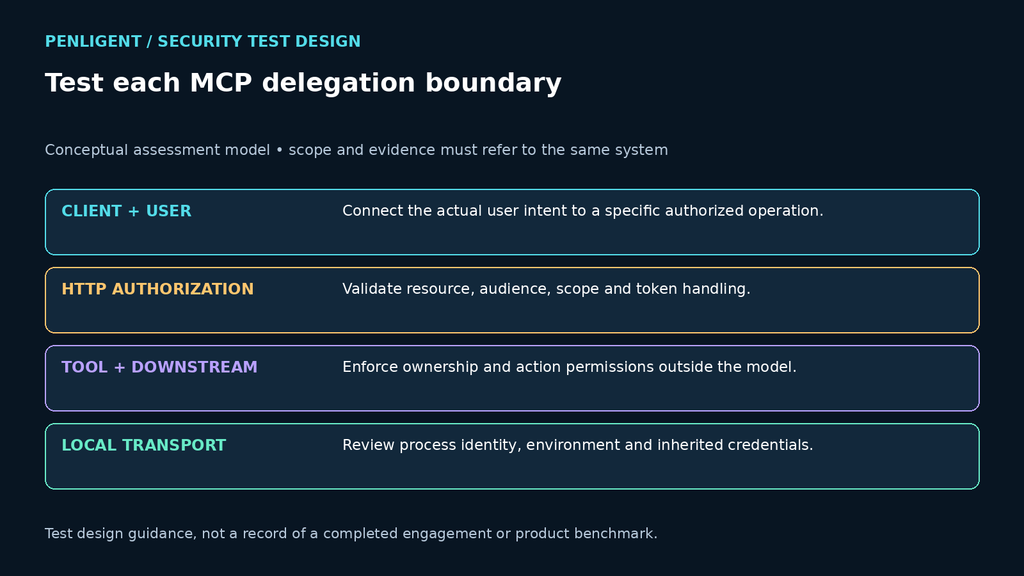
MCP security testing should verify every delegation boundary between the user, AI client, MCP server, authorization service, tool and downstream system. A server can implement the protocol correctly and still expose excessive tools, accept over-broad tokens or let untrusted content influence privileged actions.
Map the trust chain
| Boundary | Failure to test | Required evidence |
|---|---|---|
| User to client | The client misrepresents which action will occur | User intent, displayed approval and exact tool request |
| Client to server | A token or session is accepted for the wrong audience | Issuer, audience, scopes and server decision |
| Server to tool | The server exposes a tool beyond the authorized task | Tool allowlist, arguments and policy result |
| Tool to downstream API | The tool trusts model-supplied object identifiers | Principal, resource ownership and downstream authorization |
| Content to model | Documents or tool output inject instructions | Content provenance and resulting plan change |
| Run to audit trail | Investigators cannot reconstruct delegated actions | Correlated identities, approvals, calls and results |
Explore Penligent for authorized security testing
Use the MCP specification and its authorization guidance as protocol references, then test the actual deployment. Product-specific proxies, local transports, identity brokers and tool wrappers can create security behavior outside the core specification.
The linked authorization specification addresses HTTP-based transports; it does not prescribe the same OAuth flow for STDIO. For a local STDIO server, assess process identity, inherited environment credentials and the caller’s operating-system permissions. Bind every test to the transport and specification version actually deployed.
Authorization tests
- Use a token issued for another resource or audience and confirm rejection.
- Remove a required scope and verify that discovery and execution are both constrained.
- Change the user or tenant while reusing client state and confirm isolation.
- Revoke authorization and verify that cached sessions and long-running tasks stop.
- Test redirect and callback handling with pre-registered safe values.
- Confirm that the server does not forward a client token to an unrelated downstream service.
Authorization should be evaluated at the resource server and again at the downstream object or action. Tool names and natural-language descriptions are not access controls.
Tool permission tests
| Tool class | Risk | Acceptance condition |
|---|---|---|
| Read-only search | Cross-tenant or overly broad retrieval | Results are filtered by trusted identity and policy |
| File access | Path traversal, secret access or unintended workspace scope | Resolved paths remain inside explicit roots |
| Command execution | Argument injection or privilege inheritance | Allowlisted operations run in isolated, least-privilege contexts |
| Messaging and tickets | Unapproved external side effects | The exact recipient and content require visible approval |
| Cloud administration | Broad credentials turn planning mistakes into infrastructure changes | Short-lived task-bound permissions and independent policy checks |
| Database action | Model-provided identifiers bypass row or tenant controls | Queries are parameterized and authorization is data-aware |
Prompt injection and confused-deputy testing
Place synthetic instructions in documents, issue descriptions, web pages and tool output. Observe whether the client changes its plan, requests new tools or attempts to disclose data. The important result is not that the model repeated the text; it is whether an unauthorized resource or action became reachable.
The OWASP LLM Top 10 provides relevant risk categories, but each MCP finding should identify the concrete authority that was misused.
Secrets and local-server risks
Inspect environment variables, configuration files, logs, crash reports, command history and child processes. Confirm that a local MCP server cannot silently inherit unrelated developer credentials. Separate tools into dedicated workers when their permissions differ materially.
Test install and update provenance for servers and dependencies. A convenient one-line installation can introduce a supply-chain and credential boundary that deserves the same review as any other privileged developer tool.
Approval and stop behavior
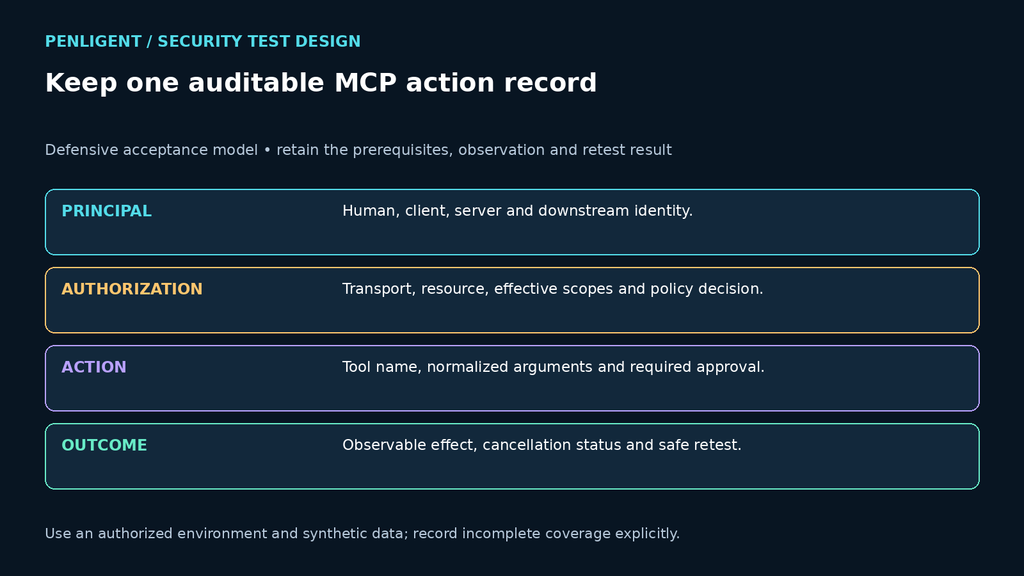
For state-changing actions, the approval should show the exact operation, target, identity and material arguments. A generic approval to “continue” should not authorize a later email, cloud change or command. Cancel an active run and verify that queued tool calls, subprocesses and callbacks terminate.
Logging requirements
- human user and client identity;
- MCP server and tool version;
- authorization issuer, audience and effective scopes;
- tool name, normalized arguments and approval event;
- downstream principal, resource and result;
- redacted error and policy decisions;
- cancellation, timeout and retry behavior.
Engagement acceptance test
Build a synthetic MCP environment with two tenants, a read tool, a state-changing tool and a decoy secret. Seed one excessive-permission condition and one indirect prompt injection. The tester should find the real authorization path, avoid accessing unrelated data, preserve an auditable chain and demonstrate a safe remediation retest.
Explore Penligent for authorized security testing
Make the purchase measurable
MCP is an integration layer, so its security cannot be assessed by protocol parsing alone. Test delegated identity, resource authorization, tool permissions, content provenance, approvals and downstream effects as one chain. AI security teams can apply the same evidence model when evaluating Penligent or another testing provider.
The following Penligent overview introduces a general authorized testing workflow. It does not demonstrate that every assessment capability discussed in this guide is included in a particular product plan.
 English
 German
 French
 Spanish
 Portuguese
 Japanese
 Korean
 Hindi
 Arabic
 Turkish
 Hebrew